
Data Center Information
Microsoft Data Center Project Information
The Town of Tyrone recognizes that residents have questions regarding the Microsoft data center project that was approved by the Town Council in March 2024. This webpage has been created to serve as a central source of information about the project, the approval process, and future review requirements.
The project was reviewed through Georgia's Development of Regional Impact (DRI) process and subsequently underwent advertised public hearings before both the Planning Commission and Town Council prior to approval. The zoning approval remains in place; however, the developer has not submitted a site plan for review and has not applied for land disturbance permits, building permits, or other development permits required before construction can begin.
Since the project's approval in 2024, data centers have become the subject of increased public discussion across the country. As a result, residents have raised questions regarding topics such as water usage, power consumption, noise, environmental impacts, tax revenue, and the Town's authority over the project. This page is intended to provide factual information, answer frequently asked questions, and explain the regulatory processes that govern future development activity.
The Town remains committed to transparency and public engagement. As additional information becomes available and future applications are submitted, this page will be updated to provide residents with timely and accurate information.
Current Status: As of May 2026, no site plan, land disturbance permit, or building permit applications have been submitted to the Town for this project.
General Information FAQs:
The rezoning request associated with the Microsoft data center project was approved by the Town Council in March 2024 following multiple public hearings and review by both the Planning Commission and Town Council. The public meeting timeline was as follows:
- February 14, 2024 - Public Hearing Signs & Advertisements Posted.
- February 22, 2024 - Planning Commission Public Hearing
- March 21, 2024 - Town Council Public Hearing
- March 28, 2024 - Town Council Approval
No. While the zoning approval remains in place, the developer has not submitted a site plan for review, nor have they applied for land disturbance permits or building permits as of 06/02/2026. Construction cannot begin until all required approvals and permits are obtained.
Once a zoning approval has been granted, legal rights are vested, local governments cannot revoke approvals. Any action taken by the Town must comply with state law and constitutional protections related to private property rights.
Georgia law does not allow zoning decisions to be decided by referendum (public vote). Zoning decisions must be made by the governing body (the Town Council) through a public hearing process and based on applicable laws, ordinances, planning documents, and evidence presented during the review process.
No. Microsoft did not request abatements or other incentives for this project. The Town did not offer a tax abatement to Microsoft.
Process & Oversight FAQs:
The project must still undergo site plan review and architectural review by the Planning Commission and staff and obtain all required permits, which may include land disturbance permits, building permits, utility approvals, stormwater approvals, and other applicable permits from local, state, and federal agencies.
Site plan and architectural approval will take place during a public meeting of the Planning Commission at the appropriate time. This project does not require additional reviews or approval by the Town Council unless Microsoft wishes to make substantive changes to its original development plan. Any future meetings regarding this project will be advertised and publicly accessible.
Yes. Prior to local approval, the project was submitted through Georgia's Development of Regional Impact (DRI) review process as required by law. The DRI process evaluates large developments for potential regional impacts, including transportation, infrastructure, water demand, and other factors. The DRI review provides information to local governments but does not replace local zoning and permitting decisions.
The full DRI report is available for public review on the Atlanta Regional Commission (ARC) website.
Water & Power FAQs:
Microsoft estimates that their facility will consume approximately 4,000 gallons of water per day once the facility is operational. It should be noted that the consumption rate will be higher during construction to mix concrete and maintain dust control amongst other items.
The Town of Tyrone does not own or operate the water system serving the community. Water service is provided by the Fayette County Water System, which is responsible for managing water resources, infrastructure, capacity planning, and customer service. As a result, decisions regarding water availability, service capacity, consumption, and any applicable restrictions are made by the water provider in accordance with its policies, regulations, and long-term planning efforts.
While the Town reviews development projects for compliance with local zoning and development regulations, the Town does not regulate how much water an individual customer or business may consume once service is approved by the water provider.
The Town of Tyrone does not generate, transmit, or regulate electrical power. Electrical service within the project area is provided by the applicable utility provider, which is responsible for planning, constructing, and maintaining the infrastructure necessary to serve its customers.
As a result, decisions regarding electrical capacity, power delivery, infrastructure upgrades, and customer consumption are made by the utility provider and, where applicable, are subject to oversight by state and federal regulatory agencies. While the Town reviews development projects for compliance with local zoning and development regulations, the Town does not regulate how much electricity an individual customer or business may consume once service is approved by the utility provider.
Questions regarding electrical demand, system capacity, reliability, or future infrastructure improvements should be directed to the utility provider serving the project.
The Town of Tyrone does not set electric rates and does not determine how utility costs are allocated among customers. Electric rates, infrastructure planning, and cost-recovery rules are handled by the utility provider and, where applicable, the Georgia Public Service Commission.
Microsoft has publicly committed that its data centers will “pay their own way” and that the electricity cost of serving its data centers should not be passed on to residential customers. Microsoft has also stated that when its data center expansion requires transmission or substation improvements, it will continue its practice of paying for those improvements.
In addition, the Georgia Public Service Commission has adopted rules and agreements intended to protect existing customers from cost shifting related to new large-load customers such as data centers. In January 2025, the PSC approved a rule allowing Georgia Power to use special terms for new customers using more than 100 megawatts, including longer contract terms, minimum billing requirements, and recovery of generation, transmission, and distribution costs associated with serving those customers.
The PSC has also stated that recent power infrastructure agreements are intended to ensure that data centers, or Georgia Power if necessary, pay for new infrastructure so existing customers do not.
Environmental FAQs:
Yes. Data centers are subject to a variety of local, state, and federal regulations related to stormwater management, erosion and sediment control, land disturbance, water service, wastewater service, air quality, and other environmental considerations. Specific requirements vary depending on the final design and applicable regulations.
Any future development must comply with applicable environmental regulations related to stormwater management, erosion control, and protected environmental resources. Site plans and engineering documents must identify and address environmental features located on or near the property. Additional permits may also be required from state or federal agencies depending on site conditions.
Development projects must comply with stormwater management requirements designed to control runoff, reduce erosion, and limit downstream impacts. Stormwater systems are reviewed by engineers during the development process and are subject to applicable local and state regulations.
Water availability and capacity are evaluated by the utility provider responsible for supplying water to the project. Any proposed water demands must be reviewed to ensure adequate system capacity exists. Questions regarding water supply planning and long-term capacity should be directed to the Fayette County Water System.
Data centers generally operate using electricity rather than manufacturing processes and typically have limited routine air emissions. However, many facilities utilize backup generators for emergency situations. Any applicable air quality permits and regulatory requirements regarding the testing of these generators are administered by the appropriate state and federal agencies. The Town will require copies of said approvals and documentation from the state.
Backup generators are intended for emergency power situations and periodic testing. Operational requirements, testing schedules, and applicable environmental regulations vary by facility and are subject to applicable permitting requirements.
The Town has authority to enforce applicable local ordinances and permit conditions and to coordinate with state and federal agencies to ensure that all environmental regulations are enforced throughout construction.
The Town's authority is limited by state and federal law. Any review requirements imposed by the Town must be authorized by applicable laws, ordinances, and development regulations. Local governments generally cannot impose arbitrary requirements that are not supported by law. This said, if Microsoft alters their plan or identifies something new as they go through the construction process, certain extra environmental procedures may e triggered.
No. Local land use decisions must be based on applicable laws, adopted regulations, and legal evidence related to the specific project under consideration. Generalized concerns, speculation, or reports involving unrelated projects in other communities are not, by themselves, a sufficient legal basis for denying a development application.
It is true that the property Microsoft purchased in Tyrone is within a designated groundwater recharge area, but so is most of Tyrone. The groundwater recharge area designation does not prevent development, it just adds more regulations that the developer must follow. Our environmental specialist put some information together on this subject:
Town of Tyrone Ordinance Audit - Data Centers
In response to Council and citizen requests, the Town conducted an internal ordinance audit and review to provide comparative analysis of recently adopted data center ordinances. This research and audit utilized institutional resources, including the Lincoln Institute of Land Policy and the Georgia Tech Energy Policy and Innovation Center (EPIcenter) Data Center Ordinance Hub, as well as primary source material directly from ordinances adopted by Georgia counties and municipalities.
Given the scope and scale of these data repositories, and because they did not include all ordinance language for each referenced municipality, a direct comparative analysis needed to be based on a smaller sampling of ordinances from their direct source. As such, Town staff pulled some of the most comprehensive Georgia ordinances referenced in the Georgia Tech EPIcenter Hub. Out-of-state ordinances were reviewed, but because Georgia has experienced a comparatively greater impact from data center development than the rest of the nation, Georgia ordinances seemed to be the most recent and comprehensive, and to provide the best legal foundation for consistency with the Georgia Constitution:
- 7 Municipalities: Adairsville, Alpharetta, Atlanta, Brookhaven, Dacula, Fairburn, South Fulton,
- 11 Counties: Bartow County, Columbia County, Coweta County, Forsyth County, Glynn County, Irwin County, Jackson County, Paulding County, Pike County, Spalding County, Troup County
And were sorted into 15 areas of impact:
- Building Placement, Design, and Size
- Maximum/Minimum Height
- Setbacks
- Parking, Loading, and Circulation
- Power
- Power Lines and Substations
- Solar
- Water & Sewer
- Noise and Vibration
- Buffer Yards, Screening, and Landscaping
- Environmental Impacts & Community Engagement
- Safety and Emergency Management
- Lighting
- Perimeter Fencing and Security
- Decommissioning and Cessation
Not every municipality or county had ordinances that covered each of the areas of impact. Those that did were listed for each area of impact along with Tyrone's ordinance to provide a benchmark comparison.
In terms of overall coverage, Tyrone covered 12 out of 15 topics. Only two other jurisdictions, Troup County and Coweta County, covered more topics, 13 and 15 respectively. This was largely because Tyrone does not provide certain utilities and therefore does not have the authority to pass ordinances that dictate utility usage in the same way as these jurisdictions. Tyrone does, however, require letters of serviceability from utilities prior to construction to confirm compliance with those providers.
Staff presented these findings to Tyrone Town Council on August 6, 2026 for their consideration.
The matrix below is sorted by area of impact, with summary ordinance information from each city and county that covered that particular area of impact, along with how the Town of Tyrone does or does not address the same impact. A comparison summary appears in the last column.
NOTE: This research was completed in July 2026 and is based on information compiled at that time. It does not reflect ordinance alterations or additional jurisdictions that have passed ordinances since then. These ordinances do not reflect every single ordinance provision placed upon development; this research is concentrated to specific areas of impact as most commonly found in Georgia data center ordinances. Other site planning and ordinance provisions will apply to any such development in Tyrone.
Impact / Restriction Area | Jurisdiction | State | Provision Summary | Tyrone Ordinance Comparison |
| Building Placement, Design & Size | Adairsville | GA | 450-acre minimum for the contiguous tract presented as a data center development. Front facade of all principal buildings oriented toward street or adjacent arterial frontage unless the front is more than 500 ft from the ROW or not visible from it. Cryptocurrency mining is expressly excluded from the data center use. Setbacks and buffers conform to the development agreement or the underlying zoning district, whichever is more restrictive. Internal-lot exception: acreage, frontage, and width standards do not apply to lots subdivided inside the campus so long as the contiguous campus complies as a whole. Private roads permitted within the campus. Compliant data centers are exempt from special use permit review under Sec. 47-393(c). Sec. 47-178(b),(c)(1),(3),(6),(8),(9),(12). | Adairsville requires a 450-acre tract against Tyrone's 10-acre minimum, but sets no cap on facility size and allows the use across a broader area. Tyrone reaches the same location outcome through the future land use plan rather than acreage: the use is permitted in one district within one character area, leaving limited eligible parcels. Tyrone also caps each building footprint at 300,000 square feet and impervious surface at 50 percent, neither of which Adairsville limits, and locks the approved development plan to the zoning so any material change re-runs the full public hearing process. |
| Building Placement, Design & Size | Alpharetta | GA | No acreage, coverage, or lot standard; regulation is entirely architectural. Road-facing principal facades must avoid undifferentiated surfaces by including at least two of: change in building height, step-backs or recesses, fenestration, change in material or pattern, or architectural accent materials. 75% of each elevation facing a public roadway must be brick, stone, or accent material, and each such elevation must be consistent in design, materials, details, and treatment. Ground-level and rooftop mechanical equipment and loading areas screened; rooftop screening provided by the principal building parapet, ground-level equipment by a visually solid screen wall of materials compatible with the principal building. Sec. 2.7.2.1(4). | Alpharetta sets no acreage, lot coverage, or building size standard and regulates almost entirely through facade composition, where its 75 percent masonry requirement exceeds Tyrone's. Tyrone applies similar screening and materially higher landscaping and siting standards through the SR-74 Quality Growth District, and adds other constraints Alpharetta lacks: a 10-acre minimum, a 50 percent impervious cap, and a 300,000 square foot cap per building footprint. Alpharetta also does not tie an approved development plan to the zoning, so its standards carry no project-specific lock. |
| Building Placement, Design & Size | Atlanta | GA | Data center floor area capped at 50% of total project floor area; active-use requirements on street frontage. | Atlanta caps data center floor area at 50 percent of total project floor area, which confines the use to an ancillary role and is a stronger scale limit than Tyrone applies in that way. It addresses no other building impact at least in this ordinance. Tyrone regulates the same concern through an absolute 300,000 square foot footprint cap, a 50 percent impervious limit, a 10-acre minimum, SR-74 architectural standards/review, and a development plan locked to the zoning. Atlanta may have since prohibited the use outright. Being a highly urbanized area, comparison is difficult. |
| Building Placement, Design & Size | Brookhaven | GA | No minimum acreage. All equipment and structures associated with the use must sit at least 50 ft from the property line and are prohibited within 200 ft of a state waters feature, measured from the point of wrested vegetation or the outer edge of a seawall. At least 35% of each exterior facade must be windows or transparent glazed elements; the Arts and Culture Commission may waive up to 25 of the 35 points for one contiguous mural on a facade fully visible from a public ROW, streetscape zone, or publicly accessible open space. Exterior materials primarily brick, wood, stucco, or stone with masonry wrapped at corners; architectural metals, textured CMU, fiber cement, and EIFS may not constitute the majority of any side. Walls exceeding 80 continuous linear feet must use offsets, recesses, floor or roofline changes, or other distinctive facade changes. The definition expressly captures blockchain and cryptocurrency mining rather than excluding it. Sec. 27-647(b)(1),(2),(3). | Brookhaven sets no minimum acreage and no building size cap, and holds all equipment and structures 50 feet from the property line against Tyrone's 25-foot side and rear standard, though Tyrone requires a 100-foot buffer where those lines abut residential or A-R. Brookhaven's 200-foot state waters setback exceeds Tyrone's 100 feet of combined buffer and impervious setback. Tyrone applies a similar architectural standard but does not have a mechanism for a waiver to these standards which Brookhaven has.Tyrone also has a stricter continuous wall variation requirement, the 300,000 square foot footprint cap, and a development plan locked to the zoning which are more restrictive than Brookhaven's default ordinance. |
| Building Placement, Design & Size | Columbia Co. | GA | A dedicated D-C Data Center District is established for data centers, research and development facilities, and associated accessory uses only, sized for operations ranging from a single building to a multi-building campus. No minimum acreage, coverage, or height standard. All buildings limited to earth-tone exterior color or finish, described as beiges, tans, greens, browns and similar, on all elevations, reviewed at building permit plan review. Server rooms and similar IT operations subordinate to a primary use are excluded from the definition. Sec. 90-147(h)(6)a.,c.k.; Sec. 90-101. | Columbia County created a dedicated D-C district but set no minimum acreage, no facility size cap, and no height limit within it, regulating building form only through an earth-tone color requirement. Tyrone applies a 10-acre minimum, a 300,000 square foot cap per building footprint, a 50 percent impervious limit, a 35-foot height standard, and full SR-74 architectural and materials review. Tyrone also locks the approved development plan to the zoning, so the scale of development is locked in at the approval stage rather than left to permit-stage administration. |
| Building Placement, Design & Size | Coweta Co. | GA | 25-acre minimum lot area; 250 ft minimum frontage; 100 ft minimum distance between buildings; 80% maximum lot coverage. Buildings must be designed to minimize adverse visual impact on surrounding development, demonstrated by elevations, architectural sketches, or sight-line studies. Elevations viewable from public roads must use at least two of brick/stone/architectural precast concrete, non-reflective architectural metal panel, or high-quality fiber cement. Facades visible from a ROW must incorporate at least two mass-breaking features: articulation at intervals not exceeding 50 ft, height variation of at least 10% across the facade or stepped rooflines, projections or recesses at least 2 ft deep, or a change of materials or colors using at least two material types. Sec. (12)a.(i),(iii),(vii),(viii),d. | Coweta requires a 25-acre minimum against Tyrone's 10 and adds an unusual 100-foot separation between data center buildings. Its 80 percent lot coverage maximum is weaker than Tyrone's 50 percent lot coverage. Tyrone's is the stricter measure because impervious area includes parking and drives. Coweta uses a similar architectural methodology at a lower materials and architectural variation standard, allows greater height, sets no cap on individual building size against Tyrone's 300,000 square feet, 35'-50' height cap, and does not tie an approved development plan to the zoning. |
| Building Placement, Design & Size | Fairburn | GA | No minimum acreage. 75% of each elevation facing a public roadway must be brick, stone, or accent material where the site lies outside the Highway 74 overlay district. Walls exceeding 250 ft in length must be articulated through plane changes, windows, recessed panels, trellis features, landscaping, wall articulation, or arcades; where a building has more than one principal facade they must be consistent in design, materials, details, and treatment. All cooling, ventilating, and operating equipment including emergency generators must be enclosed or encompassed on three sides by an opaque barrier wall of durable non-weathering material, originating no higher than 18 in above finished grade and extending at least 12 in above the tallest screened equipment, continuous and solid with no gaps, with no access gate visible from any public street or common or open area. The definition expressly includes water cooling towers, generators, fuel storage cells, and utility substations as associated components. Sec. 80-241, Exhibit A, Development Standards 4. | Fairburn requires a higher masonry percentage on road-facing elevations than Tyrone, and specifies opaque three-sided barrier walls for cooling and generator equipment in more detail than Tyrone's ordinance states. Tyrone's SR-74 architectural standards cover equipment screening and the Town's numeric noise limits imply the sound attenuation that will need to be tested and demonstrated prior Fairburn addresses directly. Fairburn sets no minimum acreage, no building size cap, and no development plan tied to the zoning, where Tyrone applies a 10-acre minimum, a 300,000 square foot footprint cap, and a plan locked at approval. |
| Building Placement, Design & Size | Forsyth Co. | GA | No acreage, coverage, or facade standard. All equipment related to ventilation and cooling systems must be contained within an enclosed building subject to the maximum height requirement, with roof ventilation permitted only where necessary. Sec. 16-4.10. | Forsyth's only building-form standard requires ventilation and cooling equipment to be contained within the enclosed structure. Tyrone does not mandate full enclosure but requires full screening of the same equipment as part of the overlay district. Beyond that provision Forsyth sets no acreage minimum, no coverage limit, no facility size cap, and no architectural standard, and does not tie an approved development plan to the zoning. Tyrone applies all of these, including the 300,000 square foot footprint cap and the 50 percent impervious limit. |
| Building Placement, Design & Size | Glynn Co. | GA | 50-acre minimum lot; 110 ft minimum lot frontage adjoining a street and 110 ft minimum width at the building line. Front facade of all principal buildings oriented toward street or adjacent arterial frontage unless the front is more than 500 ft from the ROW or not visible from it. Accessory structures follow the standards of the applicable zoning district, but guard houses and secured entry features are permitted at public road entrances notwithstanding other code provisions. Internal development roads may be public or private and are subject to county engineering standards. Sec. 4.6.4.A.3,4,5,8,10,11. | Glynn requires a 50-acre minimum lot against Tyrone's 10, which is stricter on a standalone basis, but is weaker in terms of lot width and has lower architectural requirements. Tyrone reaches the same property location restriction as a result of the future land use plan, which confines the use to one district in one character area and leaves very limited eligible parcels. Glynn sets no cap on facility size, no impervious limit, and no development plan tied to the zoning, where Tyrone caps each footprint at 300,000 square feet and locks the scale of the development at zoning approval. |
| Building Placement, Design & Size | Irwin Co. | GA | 50-acre minimum parcel unless the Board of Commissioners grants a variance on a demonstration of no adverse impact to infrastructure or natural resources. Floor area ratio capped at 0.5. All structures require permanent concrete foundations; exterior facades in muted earth tones and free of defects, decay, or corrosion; shipping containers, railroad cars, semi-truck trailers, and similar temporary storage units prohibited. Prefabricated, pre-engineered, and modular structures are permitted subject to those standards. Sites must lie outside any FEMA-designated Special Flood Hazard Area, have direct access to a state or federal highway or a county road capable of accommodating heavy truck traffic as determined by the County Engineer, and may not sit within one mile of an incorporated municipal boundary unless coordinated with that municipality. Commercial cryptocurrency mining is prohibited countywide. Sec. 27-3(d); Sec. 27-4(a)(1)-(4),(8). | Irwin requires a 50-acre minimum parcel, subject to a variance process, against Tyrone's 10 acres. Its 0.5 floor area ratio is weaker than Tyrone's absolute cap: a 50-acre site could carry more than 1,000,000 square feet of building, where Tyrone caps each footprint at 300,000. Architectural requirements are lower than Tyrone's SR-74 standards, and Tyrone already addresses traffic and circulation through traffic impact studies, circulation plans, and rear-located loading bays. Tyrone also locks the approved development plan to the zoning. |
| Building Placement, Design & Size | Jackson Co. | GA | 10-acre minimum lot size for any data center. Primary buildings must be constructed of materials with demonstrated sound-attenuation properties such as tilt-up concrete panels or concrete masonry units; metal panel construction is permitted only where the applicant demonstrates through acoustical analysis that the building envelope will meet the County's property-line noise standard. The definition expressly captures hyperscale, enterprise, colocation, edge, high-performance computing, and blockchain operations, and the amendment strikes computer and data processing services from the business service establishment definition so the use cannot be classified by-right under that heading. Sec. 3-045(a),(e)(4); Art. 2 Div. III. | Jackson sets a 10-acre minimum matching Tyrone's and requires sound-attenuating construction materials, a provision Tyrone does not state directly though its numeric noise limits imply the same outcome. Jackson's architectural standard is lower than Tyrone's SR-74 requirements, and it sets no cap on facility size, no impervious limit, and no height standard, where Tyrone applies a 300,000 square foot footprint cap, a 50 percent impervious limit, and a 35-foot height standard. Jackson does not tie an approved development plan to the zoning. |
| Building Placement, Design & Size | Paulding Co. | GA | Technology Park Overlay District applied to approximately 995 acres across twelve named tax parcels, with no boundary change permitted except by Board of Commissioners action under Chapter 280. 50-acre minimum lot acreage; 50% maximum total building coverage as a percentage of lot area; 150 ft minimum public road frontage; 110 ft minimum lot width at the building line. Front facade of all principal buildings oriented toward street or adjacent arterial frontage unless more than 500 ft from the ROW or not visible from it. Internal-lot exception: underlying-district frontage, width, and acreage do not apply to lots subdivided inside the overlay so long as the contiguous overlay complies as a whole. Sec. 220-40.02, .04, .07.B, .09. | Paulding requires a 50-acre minimum against Tyrone's 10 and applies a 50 percent building coverage maximum comparable to Tyrone's 50 percent impervious cap, though the impervious measure is the stricter of the two because it includes parking and drives. Paulding's architectural standard is lower than Tyrone's SR-74 requirements and it permits substantially larger buildings, setting no equivalent to Tyrone's 300,000 square foot footprint cap. Paulding also does not tie an approved development plan to the zoning. |
| Building Placement, Design & Size | Pike Co. | GA | 10-acre minimum lot area for all data centers, permitted only by special use permit in M-1. Siting is confined to US Highway 41 frontage or a platted industrial park. On a corner or double-frontage lot on US 41 the facility may only be entered from the state highway; no county road entrance is permitted except an internal road within a platted industrial park. Sec. Data Centers a., g. | Pike sets a 10-acre minimum matching Tyrone's and confines siting to US Highway 41 frontage or a platted industrial park, which is similar to Tyrone's. Tyrone's limitations are narrower in that we only allow one district within one character area, leaving limited eligible parcels with the nearest town residence 1,000 to 2,000 feet away. Pike sets no cap on facility size, no impervious limit, and no architectural standard, permitting larger buildings across a broader area, and does not tie a development plan to the zoning. |
| Building Placement, Design & Size | South Fulton | GA | 20-acre minimum lot area. Building facades facing adjacent public roads and exceeding 250 ft in length must be articulated through plane changes, windows, recessed panels, trellis features, landscaping, wall articulation, or arcades. Loading bays in facades facing public roads or adjacent residential uses must be screened from view. Equipment used for cooling, ventilating, or powering the facility, including emergency generators, when located closer to a public road or residential use than the principal building, must be contained within an enclosed building or encompassed on three sides by an opaque barrier extending at least 12 in above the equipment and screened with dense vegetation. Sec. 302.48(a),(e). | South Fulton requires a 20-acre minimum against Tyrone's 10 which is stricter on its own, and specifies generator and cooling equipment containment in more detail than Tyrone's ordinance states, though Tyrone requires the same equipment to be screened under the Overlay district. South Fulton's material requirements are weaker than Tyrone's, it sets no cap on overall building size against Tyrone's 300,000 square foot footprint limit, and it does not tie an approved development plan to the zoning. |
| Building Placement, Design & Size | Spalding Co. | GA | No minimum acreage. Data centers, expressly excluding Bitcoin mining, are a special exception in C-1C and may only be located within a planned commercial or industrial development. Prohibited in S-2, S-3, and S-4 sensitive land protection districts and subject to the standards of any overlay district, including airport overlay restrictions. Exterior walls facing roads or residential property may not be all metal and must consist of at least 40% stone or masonry facade. All mechanical equipment fully screened with opaque fencing per Sec. 407; rooftop equipment screened with parapets. Sec. 1403A.B.8.a-d,f. | Spalding permits the use in more zoning categories than Tyrone, which allows it only in BTP within one character area. Its 40 percent stone or masonry requirement for facades facing residential property is slightly stricter than Tyrone's 35 percenbt material standard. Spalding sets no cap on building size against Tyrone's 300,000 square foot footprint limit, no impervious or coverage maximum against Tyrone's 50 percent, and no minimum acreage. It also does not tie an approved development plan to the zoning, so its standards carry no project-specific lock at the time of zoning. |
| Building Placement, Design & Size | Troup Co. | GA | No minimum acreage. Parcels must be large enough to satisfy all setbacks and standards, a performance test rather than a fixed threshold. All principal and accessory structures placed at least 1,500 ft from the property lines of sensitive receptor sites. Buildings sited and oriented to minimize bulk on a line-of-sight basis from public streets and sensitive receptors. Multi-building campuses encouraged to transition from smaller/lower buildings at street frontage to larger/taller on the interior, with topography considered. Exterior colors limited to low-reflective, subtle, or earth tones; fluorescent and metallic prohibited. Facilities over 500,000 gsf or 200 acres trigger DRI review through Three Rivers Regional Commission. Sec. 7.7(3)(a),(d),(s). | Troup places all structures 1,500 feet from sensitive receptor property lines, but applies lower architectural requirements and sets no minimum acreage, no explicit impervious limit, and no facility size cap. Tyrone reaches similar separation through the future land use plan rather than ordinance text: BTP-eligible parcels sit 1,000 to 2,000 feet from Tyrone residences and the plan prevents new homes adjacent to them. Tyrone adds a 300,000 square foot footprint cap, a 50 percent impervious limit, and a development plan locked to the zoning. |
| Building Placement, Design & Size | TYRONE (Town of Tyrone) | GA | 10-acre minimum development; 50% max impervious surface; 300,000 sf cap per building footprint; approved development plan locked to the zoning. SR-74 Quality Growth District adds elevations, materials schedule, and line-of-sight study. Sec. 113-138(a),(e)(1),(e)(8)-(10),(h)(1); Sec. 113-191. | Tyrone is more restrictive than most Georgia peers on facility size. The 300,000 square foot cap per building footprint could not be identified in the other ordinances researched at the time this research was conducted.The 50 percent impervious surface cap is stricter than a majority of the lot coverage maximums peers use, because impervious area includes parking and drives. Six Georgia jurisdictions (at the time of this research) require more acreage than Tyrone's 10 acres, but acreage is not the only way Tyrone controls location: the future land use plan confines the use to one district in one character area, leaving very few eligible parcels. Troup is comparable in terms of restrictions with very high distancing ordinances. |
Impact / Restriction Area | Jurisdiction | State | Provision Summary | Tyrone Ordinance Comparison |
| Maximum/Minimum Height | Adairsville | GA | 75 ft maximum measured from structure pad level. The cap does not apply to accessory structures such as water towers, conveyor belts, HVAC equipment, generators, and other incidental and uninhabited parts of the structure, so screened mechanical and cooling equipment is unbounded. Sec. 47-178(c)(2). | Adairsville permits 75 feet measured from structure pad level and exempts water towers, conveyor belts, HVAC equipment, and generators from the cap entirely, leaving screened mechanical equipment unbounded. Tyrone allows 35 feet as of right and up to 50 feet only with increased front setback, berming, or both, and increases the side and rear setback by 5 feet for every foot above 35 where the site adjoins residential or A-R. Tyrone's cap is less than half Adairsville's before the exemptions are counted. |
| Maximum/Minimum Height | Alpharetta | GA | Sets a 20 ft MINIMUM height, not a maximum. Design-driven, not impact-driven. Excluded from the height median. Sec. 2.7.2.1(3). | Alpharetta sets a 20-foot minimum rather than a maximum, so its standard is design-driven and imposes no ceiling on building height at all. Tyrone allows 35 feet as of right and up to 50 feet only with increased front setback, berming, or both, and increases the side and rear setback by 5 feet for every foot above 35 where the site adjoins residential or A-R. |
| Maximum/Minimum Height | Coweta Co. | GA | 60 ft building height with up to an additional 10 ft for parapet and rooftop equipment, not to exceed 70 ft total, subject to applicable federal, state, and local regulations. Sec. (12)a.(ii). | Coweta permits 60 feet with an additional 10 feet for parapet and rooftop equipment, to 70 feet total. Tyrone allows 35 feet as of right and up to 50 feet only with increased front setback, berming, or both, and increases the side and rear setback by 5 feet for every foot above 35 where the site adjoins residential or A-R. Tyrone's as-of-right standard is 25 feet below Coweta's base allowance, and reaching 50 feet requires compensating site measures rather than an administrative allowance. |
| Maximum/Minimum Height | Fairburn | GA | 60 ft for all buildings, structures, and appurtenances on the property, unless approved by the fire marshal. Measured as the vertical distance from finished grade to the highest point of the structure, so the cap is inclusive rather than base-height. Sec. 80-241, Exhibit A, Development Standards 1. | Fairburn permits 60 feet measured to the highest point of the structure, with the fire marshal able to approve more. Tyrone allows 35 feet as of right and up to 50 feet only with increased front setback, berming, or both, and increases the side and rear setback by 5 feet for every foot above 35 where the site adjoins residential or A-R. |
| Maximum/Minimum Height | Forsyth Co. | GA | 20 ft MINIMUM height, driven by the requirement that all ventilation and cooling equipment sit inside the enclosed building. Excluded from the height median. Sec. 16-4.10. | Forsyth sets a 20-foot minimum rather than a maximum, driven by the requirement that cooling equipment sit inside the enclosed building, so it imposes no ceiling on height. Tyrone allows 35 feet as of right and up to 50 feet only with increased front setback, berming, or both, and increases the side and rear setback by 5 feet for every foot above 35 where the site adjoins residential or A-R. Tyrone regulates the same equipment through screening while still capping overall building height. |
| Maximum/Minimum Height | Glynn Co. | GA | 75 ft measured from structure pad level. The limit does not apply to accessory structures such as water towers, conveyor belts, smokestacks, and other incidental and uninhabited parts of industrial uses. Sec. 4.6.4.A.1. | Glynn permits 75 feet from structure pad level and exempts water towers, conveyor belts, smokestacks, and other incidental industrial elements from the cap. Tyrone allows 35 feet as of right and up to 50 feet only with increased front setback, berming, or both, and increases the side and rear setback by 5 feet for every foot above 35 where the site adjoins residential or A-R. Tyrone's standard is less than half Glynn's and carries no comparable exemption for uninhabited structures. |
| Maximum/Minimum Height | Irwin Co. | GA | 100 ft, plus up to an additional 15 ft for parapet and rooftop equipment, not to exceed 115 ft total. Highest cap in the database. Sec. 27-4(a)(7). | Irwin permits 100 feet plus 15 feet for parapet and rooftop equipment, to 115 feet total, the highest allowance in this database. Tyrone allows 35 feet as of right and up to 50 feet only with increased front setback, berming, or both, and increases the side and rear setback by 5 feet for every foot above 35 where the site adjoins residential or A-R. Tyrone's as-of-right standard is roughly one third of Irwin's base allowance. |
| Maximum/Minimum Height | Paulding Co. | GA | 75 ft measured from structure pad level. The cap does not apply to accessory structures such as water towers, conveyor belts, HVAC equipment, generators, and other incidental and uninhabited parts of the structure, and the Community Development Director may allow taller elements upon demonstration of technical or mechanical necessity. Sec. 220-40.05. | Paulding permits 75 feet from structure pad level, exempts water towers, HVAC equipment, and generators, and allows the Community Development Director to approve taller elements on a showing of technical necessity. Tyrone allows 35 feet as of right and up to 50 feet only with increased front setback, berming, or both, and increases the side and rear setback by 5 feet for every foot above 35 where the site adjoins residential or A-R. Tyrone provides no administrative path above 50 feet. |
| Maximum/Minimum Height | South Fulton | GA | 40 ft transitional cap applied for a horizontal distance of 100 ft measured from a common property line with land used for single-family residential purposes. No general height cap otherwise. Sec. 302.48(b). | South Fulton applies a 40-foot cap only within 100 feet of a common line with single-family residential property and sets no general height limit beyond that transitional band. Tyrone allows 35 feet as of right and up to 50 feet only with increased front setback, berming, or both, and increases the side and rear setback by 5 feet for every foot above 35 where the site adjoins residential or A-R. Tyrone's cap applies across the entire site rather than at a single edge condition. |
| Maximum/Minimum Height | Troup Co. | GA | Maximum 60 ft for all structures regulated under the subsection, with no stated exemption for rooftop mechanical equipment, cooling towers, or HVAC. Sec. 7.7(3)(e). | Troup permits 60 feet for all regulated structures with no stated exemption for rooftop mechanical equipment or cooling towers, which makes it an inclusive cap. Tyrone allows 35 feet as of right and up to 50 feet only with increased front setback, berming, or both, and increases the side and rear setback by 5 feet for every foot above 35 where the site adjoins residential or A-R. Tyrone's as-of-right standard is 25 feet below Troup's, and the 50-foot ceiling is conditional rather than automatic. |
| Maximum/Minimum Height | TYRONE (Town of Tyrone) | GA | 35 ft as of right; up to 50 ft only with increased front setback, berming, or both. Side and rear setback increases 5 ft per foot of height above 35 ft where adjacent to residential or A-R. Sec. 113-138(e)(7). | Tyrone is more restrictive than each Georgia jurisdiction reviewed at the time of this research that sets a height standard. The 35-foot as-of-right cap is the lowest in this research, and 50 feet is available only in exchange for increased front setback, berming, or both, with side and rear setbacks increasing 5 feet for every foot above 35 where the site adjoins residential or A-R. Peers range from 60 to 100 feet, most exempt rooftop mechanical equipment, water towers, and generators from the cap entirely, and two set minimum heights rather than maximums which Tyrone's overlay district already covers. |
Impact / Restriction Area | Jurisdiction | State | Provision Summary | Tyrone Ordinance Comparison |
| Setbacks | Adairsville | GA | No fixed setback. All buffers and setbacks conform to the development agreement or the requirements of the underlying zoning district, whichever is most restrictive, so the separation standard is negotiated rather than codified. Required setbacks apply only to external boundaries with properties outside the campus. Sec. 47-178(c)(3)b.,(8). | Adairsville sets no fixed setback and defers to the development agreement or the underlying zoning district, whichever is more restrictive, so its separation standard is negotiated rather than codified and varies with whichever districts permit the use. Tyrone permits the use in one district within one character area, so the default is known and consistent. Tyrone reaches similar separation through the future land use plan rather than ordinance text: BTP zoning exists in one character area, eligible parcels sit 1,000 to 2,000 feet from Tyrone residences. The development plan process has also imposed 300-foot setbacks against a 100-foot district standard in the case of Microsoft and leaves room for higher negotiated setbacks during the public hearing process than the default BTP district states. |
| Setbacks | Alpharetta | GA | No data center building may be located within 100 ft of a collector or local roadway. Site line studies must be provided to confirm screening of equipment from adjacent roads and properties. This is a roadway setback rather than a residential separation, so no value enters the residential-separation median. Sec. 2.7.2.1(4)e. | Alpharetta holds buildings 100 feet from a collector or local roadway and requires site line studies, which is the same as Tyrone's 100-foot standard along major arterials and arterials. Neither sets a residential separation. Tyrone adds a 100-foot buffer where a side or rear line abuts residential or A-R, which Alpharetta does not, and reaches actual separation through the future land use plan and the development plan process, which has been used to impose a 300-foot setback above the district default. |
| Setbacks | Brookhaven | GA | All equipment and structures associated with the use must sit a minimum of 50 ft from the property line. Structures are separately prohibited within 200 ft of a state waters feature. A generic all-property-line standard with no residential-specific figure. Sec. 27-647(b)(1),(2). | Brookhaven holds all equipment and structures 50 feet from the property line generally, which exceeds Tyrone's 25-foot side and rear standard against a non-residential neighbor. Where the line abuts residential or A-R, Tyrone requires a 100-foot buffer, twice Brookhaven's requirement, and Brookhaven sets no residential-specific separation as far as can be seen from the text pulled. Tyrone reaches large separation through the future land use plan rather than ordinance text: BTP zoning exists in one character area, eligible parcels sit 1,000 to 2,000 feet from Tyrone neighborhoods, and the plan blocks new adjacent homes. The development plan process has also imposed 300-foot setbacks against a 100-foot district minimum standard in a few locations. |
| Setbacks | Coweta Co. | GA | 75 ft minimum front yard; 100 ft minimum side yard; 100 ft minimum rear yard; 100 ft minimum distance between buildings. Substations are separately held 300 ft from any adjacent public road or residentially zoned property. Sec. (12)a.(iv)-(vii), q. | Coweta requires 75 feet front and 100 feet side and rear, and separately holds substations 300 feet from any public road or residentially zoned property. Tyrone applies no equivalent substation setback in text, but the development plan process reached the same result: the substation was placed behind the buildings at the north end of the site, furthest from Tyrone properties, as a condition of the approved plan. Tyrone reaches similar separation through the future land use plan rather than ordinance text: BTP zoning exists in one character area, eligible parcels sit 1,000 to 2,000 feet from Tyrone residences, and the plan does not account for new residential to locate adjacent to the use. The development plan process has also imposed 300-foot setbacks against a 100-foot district standard in a few areas to achieve better separation. |
| Setbacks | Fairburn | GA | No data center building or appurtenance may be located within 100 ft of a collector or local roadway; the Mayor and City Council may consider sites which intersect an arterial or higher classification roadway. Site line studies required to confirm screening from adjacent roads and properties. A roadway setback rather than a residential separation. Sec. 80-241, Exhibit A, Development Standards 6.a.,b. | Fairburn holds buildings 100 feet from a collector or local roadway, matching Tyrone's arterial standard, but sets no residential separation from what could be seen in this ordinance. Tyrone's 100-foot buffer where a side or rear line abuts residential or A-R is an objective standard applied without case-by-case judgment. Tyrone reaches similar separation through the future land use plan rather than ordinance text: BTP zoning exists in one character area, eligible parcels sit 1,000 to 2,000 feet from Tyrone residents, and the plan blocks new adjacent homes. The development plan process has also imposed 300-foot setbacks against a 100-foot district standard in some areas. |
| Setbacks | Forsyth Co. | GA | 100 ft minimum setback along all lot lines abutting a residential, OR, A1, or Ag-Res zoning district. Sec. 16-4.10. | Forsyth requires 100 feet along lot lines abutting residential, OR, A1, or Ag-Res districts, which is similar to Tyrone's 100-foot residential buffer. The difference is where the use may go: Forsyth permits it across a broader set of zoning classifications, so the standard is applied at many more edges. Tyrone permits the use in one district within one character area. Tyrone reaches comparable separation through the future land use plan rather than ordinance text: BTP zoning exists in one character area, eligible parcels sit 1,000 to 2,000 feet from Tyrone residences, and the plan does not call for new adjacent homes. The development plan process has also imposed 300-foot setbacks against a 100-foot district standar in some areas. |
| Setbacks | Glynn Co. | GA | 50 ft front, side, and rear yard setback. A generic all-yard standard with no residential-specific figure. Sec. 4.6.4.A.2. | Glynn requires 50 feet front, side, and rear as a generic all-yard standard with no residential-specific figure. Tyrone requires 100 feet from major arterials and arterials and a 100-foot buffer where a side or rear line abuts residential or A-R, twice Glynn's. Tyrone reaches comparable separation through the future land use plan rather than ordinance text: BTP zoning exists in one character area, eligible parcels sit 1,000 to 2,000 feet from Tyrone neighborhoods, and the plan blocks new adjacent homes. The development plan process has also imposed 300-foot setbacks against a 100-foot district standard in some areas that were deemed sensitive. |
| Setbacks | Irwin Co. | GA | 300 ft from front property lines and 300 ft from side and rear property lines. Separately, the data center building must sit at least 1,000 ft from the structure of any existing residential dwelling, measured from the nearest point of the building to the residential structure. A facility may be built inside 1,000 ft only if the owner of that dwelling provides written consent and agreement to the County, or the dwelling is moved out of the 1,000 ft radius before any land disturbance permit issues. A further 1,000 ft separation applies to schools, places of worship, hospitals, and public parks. Sec. 27-4(a)(4)(ii),(iii),(5). | Irwin requires 300 feet from all property lines and 1,000 feet from any existing residential dwelling, waivable by written owner consent or by relocating the dwelling. This is larger than Tyrone's 100-foot arterial setback and 100-foot residential buffer on its own. Tyrone reaches similar separation through the future land use plan rather than ordinance text: BTP zoning exists in one character area, eligible parcels sit 1,000 to 2,000 feet from Tyrone neighborhoods, and the plan blocks new adjacent homes. The development plan process has also imposed 300-foot setbacks against a 100-foot district standard along property lines that had sensitive receptors in the County. Actual separation is comparable, and Tyrone's is not subject to a waiver which it appears Irwins is. |
| Setbacks | Jackson Co. | GA | 1,000 ft minimum separation from any existing residence, measured from the nearest point of the data center building to the residential structure. From public road rights-of-way: 150 ft from major arterials, collectors, and designated corridor roads with required vegetative or architectural screening, and 100 ft from local industrial access roads with vegetative screening where visible from the ROW. Sec. 3-045(c)(1),(3). | Jackson requires 1,000 feet from any existing residence and 150 feet from major arterials and collectors, which on its pwn exceeds Tyrone's 100-foot arterial setback and 100-foot residential buffer. Tyrone reaches comparable separation through the future land use plan rather than ordinance text: BTP zoning exists in one character area, eligible parcels sit 1,000 to 2,000 feet from Tyrone residences, and the plan blocks new adjacent homes. The development plan process has also imposed 300-foot setbacks against a 100-foot district standard along property lines that had sensitive receptors. Actual separation is comparable, and Tyrone's is fixed by the approved plan rather than measured to whatever dwelling exists at the time of application. |
| Setbacks | Paulding Co. | GA | 75 ft minimum front, side, and rear yard setback. Where a property line abuts a residential district or use, the 100 ft undisturbed buffer under Sec. 220-40.06 governs and expressly includes rather than adds to the required setback, so effective residential separation is 100 ft, not 175 ft. Sec. 220-40.04.E-G, .06. | Paulding requires 75-foot front, side, and rear yards, and where a line abuts residential its 100-foot buffer expressly includes rather than adds to the setback, so residential separation is 100 feet. Tyrone requires 100 feet from major arterials and arterials and a 100-foot residential buffer . Tyrone reaches comparable separation through the future land use plan rather than ordinance text: BTP zoning exists in one character area, eligible parcels sit 1,000 to 2,000 feet from Tyrone residences, and the plan blocks new adjacent homes. The development plan process has also imposed 300-foot setbacks against a 100-foot district standard along property lines with potential sensitive receptors in the County |
| Setbacks | Pike Co. | GA | 500 ft from any habitable structure and 100 ft from property lines. A 150 ft buffer applies to all streams and all state wetland buffers are enforced. Sec. Data Centers c. | Pike requires 500 feet from any habitable structure and 100 feet from property lines, which on its own exceeds Tyrone's 100-foot arterial setback and 100-foot residential buffer. Tyrone reaches comparable separation through the future land use plan rather than ordinance text: BTP zoning exists in one character area, eligible parcels sit 1,000 to 2,000 feet from Tyrone neighborhoods, and the plan blocks new adjacent homes. The development plan process has also imposed 300-foot setbacks against a 100-foot district standard along some property lines with sensitive receptors in the County. Actual separation is comparable, and Pike's standard is measured to habitable structures rather than to the property line, so it changes somewhat as adjacent land develops. |
| Setbacks | Spalding Co. | GA | 100 ft minimum building setback for principal data center buildings from any property line adjacent to residential property; 50 ft minimum from all property lines adjacent to nonresidential property. Sec. 1403A.B.8.g. | Spalding requires 100 feet from property lines adjacent to residential and 50 feet from nonresidential lines, which tracks Tyrone's 100-foot residential buffer. Spalding's ordinance represents the ceiling of what it can require, while Tyrone's development plan process allows setbacks above the district default and has been used that way, with a 300-foot setback imposed in several locations against a 100-foot standard. Tyrone reaches comparable separation through the future land use plan rather than ordinance text: BTP zoning exists in one character area, eligible parcels sit 1,000 to 2,000 feet from Tyrone neighborhoods, and the plan blocks new adjacent homes. |
| Setbacks | Troup Co. | GA | All principal and accessory structures set back 1,500 ft from the property lines of sensitive receptors, measured to the receptor's property line rather than to the dwelling. Retention/detention ponds and utility substations set back 300 ft from sensitive receptor property lines. Parking lots set back 150 ft from public road rights-of-way and 100 ft from all property lines. Ground-mounted equipment prohibited in any required setback. Sensitive receptors established after issuance of a certificate of completion or occupancy do not trigger the standard. Sec. 7.7(3)(d)(i),(f),(h)(8). | Troup places all structures 1,500 feet from sensitive receptor property lines, which is the strongest text standard in this database, and holds ponds and substations at 300 feet. On its own that exceeds Tyrone's 100-foot arterial setback and 100-foot residential buffer. Tyrone reaches similar separation through the future land use plan rather than ordinance text: BTP zoning exists in one character area, eligible parcels sit 1,000 to 2,000 feet from Tyrone neighborhoods, and the plan blocks new adjacent homes. The development plan process has also imposed 300-foot setbacks against a 100-foot district standard. This said, Troup's setback and separation ordinances are the most strict out of the ordinances reviewed at the time this research was conducted. |
| Setbacks | TYRONE (Town of Tyrone) | GA | 100 ft from major arterials and arterials; 65 ft from collectors and minor thoroughfares; 25 ft side and rear; 100 ft buffer where a side or rear line abuts residential or A-R. Sec. 113-138(e)(3)-(6). Actual siting separation is roughly 1,000-2,000 ft. | Tyrone's ordinance text understates actual separation mechanisms. A few Georgia peers have larger residential separations than Tyrone's 100-foot arterial setback and 100-foot residential buffer, ranging from 500 to 1,500 feet in their ordiances, but Tyrone reaches comparable distance through the future land use plan rather than the zoning text alone: BTP-eligible parcels sit 1,000 to 2,000 feet from Tyrone residences, and the plan prevents new homes adjacent to them. The development plan process adds flexibility most peers do not have which can encourage setbacks above the district default. It has been used that way, with a 300-foot setback imposed against a 100-foot standard along certain property lines. This comparison looks at the combination of the Town's ordinacnes and land-use planning practices as a whole as opposed to just ordinance text alone. |
Impact / Restriction Area | Jurisdiction | State | Provision Summary | Tyrone Ordinance Comparison |
| Parking, Loading & Circulation | Athens-Clarke Co. | GA | 1 space per 700 sf gross plus 1 per company vehicle. ITE Trip Generation compliance required. | Athens-Clarke requires one space per 700 square feet of gross floor area plus one per company vehicle, and requires ITE Trip Generation compliance. At roughly six times Tyrone's ratio it mandates substantially more paving. Tyrone's ratio of one space per 4,000 square feet limits unnecessary paving rather than guaranteeing supply on a future use of what the building coud become, and is backed by a 50 percent impervious cap. Granular detail is settled at site plan, where staff will press against paving beyond what the use requires. Athens-Clarke applies no impervious or coverage cap in this ordinance itself, so total paved area is likely higher than Tyrone's 50% cap. Its ITE trip generation requirement parallels the traffic impact study Tyrone requires at the development plan stage. |
| Parking, Loading & Circulation | Columbia Co. | GA | No established minimum or maximum number of off-street spaces. The count is set by the number of employees associated with the actual use and determined in conjunction with site plan review. Sec. 90-147(h)(6)c.g. | Columbia County sets no minimum or maximum space count at all and determines the number at site plan review based on employee count. Tyrone's ratio of one space per 4,000 square feet limits unnecessary paving rather than guaranteeing supply, and is backed by a 50 percent impervious cap. Granular detail is settled at site plan, where staff will press against paving beyond what the use requires. Columbia applies no impervious or coverage cap, so nothing in its ordinance limits total paved area once the count is agreed. |
| Parking, Loading & Circulation | Coweta Co. | GA | The applicant must set aside land area to accommodate 1 space per 2,000 sf of gross floor area, but the number actually constructed is determined by a parking analysis submitted by the applicant and approved by the Public Works Administrator. A construction traffic management plan is required before land disturbance, reviewed by Community Development with Public Works, the Fire Chief, and the Sheriff, and a surety bond may be required for damage to public roads. Transportation improvements needed to serve the development must be designed with the site plans and under construction before any building permit for permanent structures. Sec. (12)j., k. | Coweta requires land set aside at one space per 2,000 square feet, double Tyrone's ratio and therefore more paving, though the constructed count is set by an approved parking analysis. Coweta adds a construction traffic management plan, Public Works review, and a possible surety bond for road damage, none of which Tyrone requires by ordinance because access is only allowed along a State Route. Tyrone's ratio of one space per 4,000 square feet limits unnecessary paving rather than guaranteeing supply, and is backed by a 50 percent impervious cap. Granular detail is settled at site plan, where staff will press against paving beyond what the use requires. |
| Parking, Loading & Circulation | Fairburn | GA | 1 space per 7,500 sf of gross floor area. Sec. 80-241, Exhibit A, Development Standards 3. | Fairburn requires one space per 7,500 square feet of gross floor area, a lower ratio than Tyrone's and therefore less paving on that measure alone but does not have a 50 percent impervious cap like Tyrone. |
| Parking, Loading & Circulation | Irwin Co. | GA | Maximum of two parking spaces for each employee assigned to the facility, based on the maximum number of employees on site at any one time. A cap, not a minimum, and not floor-area based. Sec. 27-4(h). | Irwin caps parking at two spaces per employee rather than setting a floor-area minimum, which is a stricter tool Tyrone's ordinance does not contain. Tyrone's overall 300,000 sq.ft. building cap and 50% impervious surface cap are stricter tools that Irwin does not have resulting in the two ordinances pursuing similar goals through different means. |
| Parking, Loading & Circulation | Paulding Co. | GA | Three spaces per 1,000 sf of employee-occupied office space, expressly excluding server storage areas. Any greater or lesser number requires the applicant to demonstrate need based on expected employees and visitors. Office-area-based, so excluded from the gross-floor-area parking median. Sec. 220-40.10. | Paulding requires three spaces per 1,000 square feet of employee-occupied office space, expressly excluding server areas, so its ratio applies to a small share of the building. Tyrone's ratio of one space per 4,000 square feet limits unnecessary paving rather than guaranteeing supply, and is backed by a 50 percent impervious cap. Granular detail is settled at site plan, where staff will press against paving beyond what the use requires. Paulding's 50 percent building coverage cap is weaker than Tyrone's 50 percent impervious cap, which counts parking and drives. |
| Parking, Loading & Circulation | South Fulton | GA | Minimum of three spaces per thousand gross square feet of office space to be occupied within the development. Office-area-based, so excluded from the gross-floor-area parking median. Sec. 302.48(i). | South Fulton requires a minimum of three spaces per 1,000 gross square feet of office space, a floor rather than a ceiling, and applies it only to office area. Tyrone's ratio of one space per 4,000 square feet limits unnecessary paving rather than guaranteeing supply, and is backed by a 50 percent impervious cap. Granular detail is settled at site plan, where staff will press against paving beyond what the use requires. South Fulton sets no impervious or coverage cap from the ordinances reviewed. |
| Parking, Loading & Circulation | Troup Co. | GA | Employee-based rather than floor-area-based: 1 space per employee on the largest shift plus 3 visitor spaces. Minimum 1 loading space, and loading spaces/bays permitted on only one elevation of the principal building. Loading docks, truck entrances, and truck drive aisles must be oriented away from and located as far as practicable from abutting sensitive receptors, with screening. Sec. 7.7(3)(f)(iii),(g),(o). | Troup ties parking to one space per employee on the largest shift plus three visitor spaces, sets parking back 150 feet from rights-of-way and 100 feet from property lines, limits loading to one building elevation, and orients truck movement away from sensitive receptors. Tyrone requires rear or side loading under the SR-74 overlay and prohibits truck maneuvering in the right-of-way. Tyrone's ratio of one space per 4,000 square feet limits unnecessary paving rather than guaranteeing supply, and is backed by a 50 percent impervious cap. Granular detail is settled at site plan, where staff will press against paving beyond what the use requires. |
| Parking, Loading & Circulation | TYRONE (Town of Tyrone) | GA | 1 space per 4,000 sf of gross office, server, equipment, and storage area; loading berth 1 per 50,000 sf; no truck maneuvering in ROW. Sec. 113-211, 113-212; SR-74 overlay requires rear/side loading. | Tyrone's ratio of one space per 4,000 square feet was set to limit unnecessary paving rather than guarantee supply, and is one of the lowest gross-floor-area requirements among Georgia peers reviewed at the time of this research. The 50 percent impervious surface cap is the constraint that matters most, because it governs total paved area regardless of what the parking count turns out to be, and this is one of the most strict coverage caps in the research performed. Irwin's cap of two spaces per employee and Coweta's construction traffic bond are tools Tyrone lacks. Granular parking design will be settled at site plan, where staff will press against any paving beyond what the use requires. |
Impact / Restriction Area | Jurisdiction | State | Provision Summary | Tyrone Ordinance Comparison |
| Power | Adairsville | GA | Before any land disturbance permit, certificate of occupancy, or other development approval, the developer must enter a development agreement acceptable to the City making the developer financially responsible for all system upgrades required to serve the project and for all costs the City incurs investigating its ability to serve. If the City cannot reasonably provide the required utilities, it may decline the agreement, and no development approval issues. A utility availability letter under Sec. 45-2 is required before any permit. Sec. 47-178(c)(13),(14). | Adairsville can require a development agreement making the developer financially responsible for system upgrades and for the City's investigation costs, and can decline that agreement outright if it cannot reasonably serve, which blocks all development approval. That leverage follows from Adairsville operating its own utilities. Tyrone provides sewer only; water is Fayette County Water and electricity is Georgia Power or Coweta-Fayette EMC, and a letter of service is required from each outside provider before permits issue. Tyrone holds equivalent leverage over sewer, where capacity verification is required before permitting, but not over power; if the developer cannot secure a letter of serviceability from EMC or GA Power, no permit is issued. |
| Power | Columbia Co. | GA | All generators must be located away from any adjacent property zoned residential or agricultural or containing ground floor residential, sited to the interior of the site or building complex to the most practical extent, and may not be placed within a buffer or building setback. Except for testing, maintenance, or commissioning, generator use is limited to backup and emergency use only, and testing must minimize noise, vibration, and traffic impacts and stay within the sound limits of the section. Before a land disturbance or building permit, whichever comes first, a letter from the utility provider must verify the owner, operator, or developer is in compliance with all provider policies, procedures, and guidelines. Sec. 90-147(h)(6)c.b.,o. | Columbia County restricts generators to backup and emergency use, bars them from buffers and setbacks, requires interior siting away from residential and agricultural property, and requires a provider compliance letter before the first permit. Tyrone provides sewer only; water is Fayette County Water and electricity is Georgia Power or Coweta-Fayette EMC, and a letter of service is required from each outside provider before permits issue. Tyrone does not regulate generator run frequency, which is difficult to prove in enforcement. Generators are assumed to serve emergency backup, and the Town's decibel noise limits govern their impact at the property line regardless. Columbia's siting and use limits are standards Tyrone does not carry. These are more noise ordinance regulations than power and something the Town can look into. |
| Power | Coweta Co. | GA | Letter of intent to serve from the applicable utility provider at rezoning or land disturbance permit, confirming preliminary coordination and that service is feasible subject to final engineering. Notwithstanding utility grid failure, no primary onsite power generation is permitted, which forecloses behind-the-meter generation as an operating mode. Generators must be classified as stationary sources and meet Tier 4 final emissions standards; dust control complies with Chapter 30. Sec. (12)o., p. | Coweta requires a letter of intent to serve, prohibits primary onsite generation notwithstanding grid failure, and requires Tier 4 final generator emissions. Tyrone's utility letter requirement matches the first. Power plants are not a permitted use in Tyrone, so this is not allowed. Generator emissions are regulated by Georgia EPD under state law, and the Town would require a copy of the EPD permit before the project advances to its next stage. Tyrone provides sewer only; water is Fayette County Water and electricity is Georgia Power or Coweta-Fayette EMC, and a letter of service is required from each outside provider before permits issue. |
| Power | Dacula | GA | No permit until written verification of feasibility from Gwinnett County Water Resources, the electrical provider, and other applicable utilities. | Dacula requires written verification of feasibility from Gwinnett County Water Resources, the electrical provider, and other applicable utilities before permit. That is the same instrument Tyrone uses. Tyrone provides sewer only; water is Fayette County Water and electricity is Georgia Power or Coweta-Fayette EMC, and a letter of service is required from each outside provider before permits issue. Neither jurisdiction supplies electricity, so both rely on the provider's own serviceability determination rather than an independent municipal capacity finding. |
| Power | Forsyth Co. | GA | With the exception of testing activities, generator use is limited to emergency backup use only. Generator testing limited to 9:00 a.m. to 5:00 p.m. Sec. 16-4.10. | Forsyth limits generator use to emergency backup except for testing and confines testing to 9:00 a.m. through 5:00 p.m. Tyrone provides sewer only; water is Fayette County Water and electricity is Georgia Power or Coweta-Fayette EMC, and a letter of service is required from each outside provider before permits issue. Tyrone does not regulate generator run frequency. Generators are assumed to serve emergency backup, and the Town's decibel noise limits govern their impact at the property line regardless. Forsyth's stated testing window is an enforceable standard Tyrone does not have, though Tyrone's numeric noise limits apply to testing at any hour.These are more noise ordinance regulations than power and something the Town can look into. |
| Power | Irwin Co. | GA | Before a certificate of occupancy, the applicant or owner must provide a letter of intent to serve from the applicable utility provider confirming preliminary coordination has occurred and that service is feasible subject to final engineering. No capacity verification, load study, or power quality standard. Sec. 27-4(e)(1). | Irwin requires a letter of intent to serve from the utility provider before certificate of occupancy, confirming preliminary coordination and feasibility subject to final engineering. That is the same instrument Tyrone uses, applied at an earlier stage in Tyrone's case since the letter is required before permits rather than before occupancy. Tyrone provides sewer only; water is Fayette County Water and electricity is Georgia Power or Coweta-Fayette EMC, and a letter of service is required from each outside provider before permits issue. Neither ordinance imposes a capacity verification beyond the provider's own letter. |
| Power | Jackson Co. | GA | A Power, Water, and Broadband Impact Study must accompany any Special Use application, including projected utility demand at build-out, proposed phasing, and identification of necessary off-site improvements or extensions. No building permit issues until the County has written confirmation from all affected utility providers that adequate service capacity will be available at project completion. Applicants must enter binding agreements with affected providers to fund and implement all necessary improvements, including monitoring, reporting, and enforcement provisions. Facilities exceeding 10 MW of power demand must submit an Energy and Sustainability Plan. Sec. 3-045(d)(1),(5),(6); (e)(2). | Jackson requires a Power, Water, and Broadband Impact Study, written confirmation from every affected provider that capacity will be available at completion, binding funding agreements with monitoring and enforcement, and an Energy and Sustainability Plan above 10 MW. Tyrone does not require a power impact study because the Town is not the power provider. Tyrone provides sewer only; water is Fayette County Water and electricity is Georgia Power or Coweta-Fayette EMC, and a letter of service is required from each outside provider before permits issue. A serviceability letter is treated as de facto confirmation of capacity, and load studies sit with Georgia Power or Coweta-Fayette EMC. |
| Power | Paulding Co. | GA | Before County approval of a land disturbance permit, the applicant must provide a letter from the electric power supplier confirming capacity and willingness to serve the project. Generator use is limited to emergency backup only except for testing, and testing is capped at two hours per day, Monday through Friday, 11:00 a.m. to 5:00 p.m. Sec. 220-40.12(3),(4), .14. | Paulding requires a capacity and willingness-to-serve letter from the electric supplier before land disturbance and caps generator testing at two hours per day, weekdays 11:00 a.m. to 5:00 p.m. Tyrone provides sewer only; water is Fayette County Water and electricity is Georgia Power or Coweta-Fayette EMC, and a letter of service is required from each outside provider before permits issue. Tyrone does not regulate generator run frequency, which is difficult to prove in enforcement. Generators are assumed to serve emergency backup, and the Town's decibel noise limits govern their impact at the property line regardless. Paulding's testing cap is a standard Tyrone does not carry.These are more noise ordinance regulations than power and something the Town can look into. |
| Power | Pike Co. | GA | Applicants must provide a letter from all utility providers during the special use permit application stating that adequate service is available or identifying what improvements are required, with all upgrades at applicant expense and completed before a certificate of occupancy. All onsite generators must be contained within sound barriers with acoustic damping features and are permitted only in side or rear yard areas. Generator testing is limited to 9:00 a.m. to 4:00 p.m. and generators may only be used in an emergency. Sec. Data Centers d., j. | Pike requires utility letters identifying any needed improvements at applicant expense, confines generators to side and rear yards inside acoustic enclosures, limits testing to 9:00 a.m. through 4:00 p.m., and otherwise permits emergency use only. Tyrone provides sewer only; water is Fayette County Water and electricity is Georgia Power or Coweta-Fayette EMC, and a letter of service is required from each outside provider before permits issue. Tyrone does not regulate generator run frequency, which is difficult to prove in enforcement. Generators are assumed to serve emergency backup, and the Town's numeric noise limits govern their impact at the property line regardless. Pike's enclosure and placement standards are requirements Tyrone does not state.These are more noise ordinance regulations than power and something the Town can look into. |
| Power | Spalding Co. | GA | Full utility availability statements covering water, sewer, natural gas, and electricity must be provided by all relevant utility companies at the time of the land disturbance permit. Minimum Tier 4F generators required. Sec. 1403A.B.8.i., k. | Spalding requires full utility availability statements for water, sewer, natural gas, and electricity at land disturbance, and Tier 4F generators. Tyrone's utility letter requirement matches the first. Generator emissions are regulated by Georgia EPD under state law, and the Town would require the EPD permit before the project advances. Tyrone provides sewer only; water is Fayette County Water and electricity is Georgia Power or Coweta-Fayette EMC, and a letter of service is required from each outside provider before permits issue.These are more noise ordinance regulations than power and something the Town can look into. |
| Power | Troup Co. | GA | Written verification from the service provider required before building permit on four points: available transmission, distribution, and substation capacity that will not adversely affect the provider's ability to meet existing and reasonably projected load demand in the surrounding service area; properly designed, rated, and sized supply equipment; sufficiency of cooling and operational systems without adverse impact to public utilities or the region; and no electrical interference, harmonic distortion, voltage fluctuation, or other power quality disturbance on or off the premises. Third-party electrical inspection required before certificate of completion or occupancy. The accessory-use definition expressly excludes generation intended to power the facility during normal operations, so behind-the-meter primary generation is not an accessory right. Sec. 7.7(3)(c); App. D Sec. D.1.2. | Troup requires written provider verification on four points before building permit: transmission, distribution, and substation capacity that will not impair service to the surrounding area; properly rated supply equipment; sufficient cooling systems; and no power quality disturbance on or off site, plus third-party electrical inspection. Tyrone does not require a power impact study because the Town is not the power provider. Tyrone provides sewer only; water is Fayette County Water and electricity is Georgia Power or Coweta-Fayette EMC, and a letter of service is required from each outside provider before permits issue. Capacity analysis sits with Georgia Power or Coweta-Fayette EMC. |
| Power | TYRONE (Town of Tyrone) | GA | No data-center-specific power provision. No generator emissions tier, testing window, or utility capacity verification requirement. Electricity is Georgia Power or Coweta-Fayette EMC, outside Town jurisdiction. Tier 1 gap. | The Town has no data-center-specific power provision other than requiring letters of serviceability since the Town is not the power provider. The Town does not have a specific generator emissions tier requirement other than requiring Georgia EPD compliance and does not have a defined testing window for generators. Many Georgia peers set indivudual standards for these. Electricity is supplied by Georgia Power or Coweta-Fayette EMC, load studies sit with those providers, and the Town requires a letter of service from each before permits issue. Generator emissions are regulated by Georgia EPD under state law, and the Town would require the EPD permit before the project advances.Generator operations are limited by Tyrone's strict decibel limitation, but do not have specific operational requirements like many ordinances. These are more noise ordinance regulations than power and something the Town can look into. |
Impact / Restriction Area | Jurisdiction | State | Provision Summary | Tyrone Ordinance Comparison |
| Power Lines & Substations | Bartow Co. | GA | Utility inventory showing power line easements as part of concept plan submittal to demonstrate site suitability. | Bartow requires a utility inventory showing power line easements as part of the concept plan submittal, used to demonstrate site suitability rather than to set a standard, and its data center text amendment remained unadopted as of the June 2026 Planning Commission recommendation. Tyrone obtains the same information through the development plan submittal. Tyrone's development plan process reaches this. The ordinance names no substation-specific standards beyond district defaults, but placement is fixed by the approved plan and relocation is a material change re-running the full public hearing process. On the approved BTP plan the substation was conditioned to sit behind the buildings at the north end, furthest from Tyrone properties. Utility-owned transmission lines are permitted to be above ground, but developer or property-owner power lines must be underground. |
| Power Lines & Substations | Columbia Co. | GA | A substation is defined as an electric facility that converts higher voltages within or separate from a data center and can operate independently for a dedicated site once directly connected to a transmission line, which brings dedicated generation-adjacent infrastructure inside the zoning definition. Substations must be screened so as not to be visible at ground level from any adjoining property or public street, with the method set at site plan review and meeting Sec. 90-139(c). No storage of vehicles or materials is permitted within the substation area. Sec. 90-147(h)(6)a.c., c.l. | Columbia County requires substations to be screened from ground-level view from any adjoining property or public street and prohibits vehicle or material storage within the substation area. Tyrone applies comparable exterior storage restrictions and overlay ordinance review. Tyrone's development plan process accounts for this. The ordinance names no substation-specific standards beyond district defaults, but placement is fixed by the approved plan and relocation is a material change re-running the full public hearing process. On the approved BTP plan the substation was conditioned to sit behind the buildings at the north end, furthest from Tyrone properties. Utility-owned transmission lines are permitted to be above ground, but developer or property-owner power lines must be underground. |
| Power Lines & Substations | Coweta Co. | GA | Substations are accessory uses to data centers and may not be located within 300 ft of an adjacent public road or residentially zoned property. All mechanical equipment, emergency generators, substations, and appurtenances must be screened from view from any public ROW or adjoining residential property by fence, wall, or vegetative berm at least 8 ft high providing a minimum opacity of 95 percent. Sec. (12)m., q. | Coweta holds substations 300 feet from any public road or residentially zoned property and requires screening at least 8 feet high with 95 percent opacity. Tyrone states no equivalent setback in text. Tyrone's development plan process reaches this. The ordinance names no substation-specific standards beyond district defaults, but placement is fixed by the approved plan and relocation is a material change re-running the full public hearing process. On the approved BTP plan the substation was conditioned to sit behind the buildings at the north end, furthest from Tyrone properties. The conditioned placement achieved comparable separation and screening on this site.Utility-owned transmission lines are permitted to be above ground, but developer or property-owner power lines must be underground. |
| Power Lines & Substations | Dacula | GA | Substation may not be within 300 ft of an adjacent ROW; screened from adjacent property lines and the ROW. | Dacula holds substations 300 feet from an adjacent right-of-way and requires screening from adjacent property lines and the right-of-way. Tyrone states no equivalent setback in text. Tyrone's development plan process reaches this. The ordinance names no substation-specific standards beyond district defaults, but placement is fixed by the approved plan and relocation is a material change re-running the full public hearing process. On the approved BTP plan the substation was conditioned to sit behind the buildings at the north end, furthest from Tyrone properties. Utility-owned transmission lines are permitted to be above ground, but developer or property-owner power lines must be underground. |
| Power Lines & Substations | Paulding Co. | GA | Electrical substations, utility lines, pump stations, water towers, and redundant/backup power supplies are permitted accessory uses within the overlay. Air conditioning units, HVAC systems, and electrical generators must be thoroughly screened from view and from noise impact from the public ROW and adjacent properties using walls, fencing, roof elements, or landscaping, and must be located not less than 100 ft from adjacent property lines. Sec. 220-40.03.A, .07.A. | Paulding requires HVAC equipment and generators to be screened from both view and noise impact and sited at least 100 feet from adjacent property lines, and lists substations among permitted accessory uses. Tyrone applies SR-74 screening review to the same equipment. Tyrone's development plan process reaches this. The ordinance names no substation-specific standards beyond district defaults, but placement is fixed by the approved plan and relocation is a material change re-running the full public hearing process. On the approved BTP plan the substation was conditioned to sit behind the buildings at the north end, furthest from Tyrone properties. Utility-owned transmission lines are permitted to be above ground, but developer or property-owner power lines must be underground. |
| Power Lines & Substations | Pike Co. | GA | Standalone utility substations are separately permitted by special use permit in M-1, with structures at least 30 ft from all property lines, enclosure by a woven wire fence at least 8 ft high flush with the ground or on a masonry footing, no outdoor vehicle or equipment storage, and a Sec. 405 buffer along side and rear lines. These standards attach to the substation as a principal use and are not written as data center accessory standards. Sec. M-1 permitted uses 3. | Pike's substation standards attach to standalone utility substations as a principal use rather than to data center accessory substations, requiring 30-foot setbacks, an 8-foot woven wire fence, and a buffer along side and rear lines. Tyrone treats the accessory substation through the development plan instead. Tyrone's development plan process reaches this. The ordinance names no substation-specific standards beyond district defaults, but placement is fixed by the approved plan and relocation is a material change re-running the full public hearing process. On the approved BTP plan the substation was conditioned to sit behind the buildings at the north end, furthest from Tyrone properties.Utility-owned transmission lines are permitted to be above ground, but developer or property-owner power lines must be underground. |
| Power Lines & Substations | South Fulton | GA | Substations are considered accessory uses to data centers and may not be located within 300 ft of an adjacent public road. An energy use study must be completed before the issuance of a land disturbance permit. Sec. 302.48(h). | South Fulton treats substations as accessory uses, holds them 300 feet from an adjacent public road, and requires an energy use study before land disturbance. Tyrone states no equivalent setback and does not require an energy use study, since load analysis sits with Georgia Power or Coweta-Fayette EMC. Tyrone's development plan process reaches this. The ordinance names no substation-specific standards beyond district defaults, but placement is fixed by the approved plan and relocation is a material change re-running the full public hearing process. On the approved BTP plan the substation was conditioned to sit behind the buildings at the north end, furthest from Tyrone properties. Utility-owned transmission lines are permitted to be above ground, but developer or property-owner power lines must be underground. |
| Power Lines & Substations | Spalding Co. | GA | Power transfer stations, generators, and other appurtenances associated with data centers must have a minimum 50-ft-wide buffer of evergreen plant material between them and adjacent residential properties, with the buffer plan approved by the Community Development Director. Sec. 1403A.B.8.h. | Spalding requires a 50-foot evergreen buffer between power transfer stations, generators, and appurtenances and adjacent residential property, with the buffer plan approved by the Community Development Director. Tyrone's 100-foot residential buffer applies to the site as a whole and exceeds that width. Tyrone's development plan addresses this. The ordinance names no substation-specific standards beyond district defaults, but placement is fixed by the approved plan and relocation is a material change re-running the full public hearing process. On the approved BTP plan the substation was conditioned to sit behind the buildings at the north end, furthest from Tyrone properties. Utility-owned transmission lines are permitted to be above ground, but developer or property-owner power lines must be underground. |
| Power Lines & Substations | Troup Co. | GA | Substations require year-round opaque landscaping or a screen wall at least 8 ft high, must be located on the side or rear of the principal building, screened from public view, and are prohibited in a required front yard. No buffer required between the principal building and an on-site substation. On-site power lines at 34.5 kV and below must be buried; burying all lines serving the property is encouraged. Substation setbacks measured from the edge of the compound to the property boundary, and substations are also subject to the 300 ft sensitive-receptor setback. Sec. 7.7(3)(f)(i),(m). | Troup requires year-round opaque screening at least 8 feet high, side or rear placement behind the principal building, a 300-foot sensitive receptor setback, and burial of on-site lines at 34.5 kV and below. Tyrone also requires lines serving the building to be placed underground. Tyrone's development plan process addresses this. The ordinance names no substation-specific standards beyond district defaults, but placement is fixed by the approved plan and relocation is a material change re-running the full public hearing process. On the approved BTP plan the substation was conditioned to sit behind the buildings at the north end, furthest from Tyrone properties. |
| Power Lines & Substations | TYRONE (Town of Tyrone) | GA | Substation location fixed by the approved BTP development plan; relocation is a material change triggering re-review. General SR-74 overlay screening applies. No dedicated substation setback or screening standard. Jurisdiction over utility-owned substations requires Town Attorney verification. | Tyrone states no substation-specific standard, where many Georgia peers do, with separations ranging from 100 to 300 feet. The Town reaches the same result through the development plan, however: substation placement is fixed by the approved plan and relocation is a material change that re-runs the full public hearing process. On the approved BTP plan for Microsoft, the substation was conditioned to sit behind the buildings at the north end of the site, furthest from Tyrone properties. Utility-owned transmission lines are permitted to be above ground, but developer or property-owner power lines must be underground. |
Impact / Restriction Area | Jurisdiction | State | Provision Summary | Tyrone Ordinance Comparison |
| Solar | Adairsville | GA | Solar, renewable, and alternative energy facilities are listed as uses expressly permitted as data centers and related technology uses, so on-site generation of this type is a permitted component rather than a conditional one. No performance, screening, or capacity standard attaches. Sec. 47-178(b)(1). | Adairsville lists solar, renewable, and alternative energy facilities as expressly permitted components of the data center use but attaches no performance, screening, or capacity standard to them. Tyrone sets no solar-specific standard. Solar installations are permitted and would be screened on the same terms as any other rooftop or ground-mounted equipment under the SR-74 Quality Growth District, and their location would be fixed by the approved development plan. Tyrone's screening requirement is the stricter of the two on the only axis either ordinance addresses. |
| Solar | Columbia Co. | GA | Solar energy systems are an allowed accessory use. When ground mounted they must be screened with a minimum structural buffer of 20 ft meeting Sec. 90-139(c)(3). When roof mounted they must be screened so as not to be visible from any adjoining property or public street, with the method determined at building plan review. Sec. 90-147(h)(6)b.h., c.i. | Columbia County allows solar as an accessory use, requires a 20-foot structural buffer for ground-mounted arrays, and requires roof-mounted arrays to be screened from adjoining property and public streets. Tyrone sets no solar-specific standard. Solar installations are permitted and would be screened on the same terms as any other rooftop or ground-mounted equipment under the SR-74 Quality Growth District, and their location would be fixed by the approved development plan. The screening outcomes are comparable; Columbia's ground-mount buffer is the one standard Tyrone does not state. |
| Solar | Paulding Co. | GA | Solar electric power generation is an expressly permitted use within the Technology Park Overlay District, in addition to the uses permitted in the underlying zoning district. No performance, screening, or capacity standard attaches. Sec. 220-40.03.I. | Paulding lists solar electric power generation as an expressly permitted use within the overlay but attaches no performance, screening, or capacity standard. Tyrone sets no solar-specific standard. Solar installations are permitted and would be screened on the same terms as any other rooftop or ground-mounted equipment under the SR-74 Quality Growth District, and their location would be fixed by the approved development plan. |
| Solar | Troup Co. | GA | All building roofs must be designed and constructed to facilitate and optimize rooftop photovoltaic installation. Roof area not covered by panels or utilities must use light-colored material with a solar reflective index of at least 78, maintained for the life of the building. On buildings over 400,000 sf, the County must confirm rooftop panels are installed and operating to supply as much of the facility's power as feasible before issuing a certificate of occupancy. The only mandatory-installation solar provision in this database. Sec. 7.7(3)(v). | Troup requires all roofs to be built solar-ready, requires uncovered roof area to meet a solar reflective index of at least 78 for the life of the building, and requires panels to be installed and operating on buildings over 400,000 square feet before certificate of occupancy. That is the only mandatory-installation solar provision in this database. Tyrone sets no solar-specific standard. Solar installations are permitted and would be screened on the same terms as any other rooftop or ground-mounted equipment under the SR-74 Quality Growth District, and their location would be fixed by the approved development plan. |
| Solar | TYRONE (Town of Tyrone) | GA | No data-center-specific solar provision. Rooftop equipment screening is addressed generally through the SR-74 overlay. | Tyrone sets no solar-specific standard, and neither do most peers. Solar is permitted and would be screened on the same terms as any other rooftop or ground-mounted equipment under the SR-74 Quality Growth District. Adairsville and Paulding also permit solar without attaching standards. Columbia County adds a 20-foot buffer for ground-mounted arrays. Troup is the outlier and the only jurisdiction in this database that mandates installation, requiring solar-ready roofs, a solar reflective index of 78 on uncovered roof area, and operating panels on buildings over 400,000 square feet. |
Impact / Restriction Area | Jurisdiction | State | Provision Summary | Tyrone Ordinance Comparison |
| Water & Sewer | Adairsville | GA | Developers seeking City utilities must request and receive a utility availability letter under Sec. 45-2 before any permit or construction. Users of more than 50,000 gpd of water or sewer must have service approved by the mayor and council, which may consider the needs of the project, the available capacity of the city, and the anticipated future needs of the city and its other customers. This is the lower of the two large-user thresholds in the database. Sec. 47-178(c)(13). | Adairsville routes any user above 50,000 gpd of water or sewer to mayor and council approval, weighing project need against available and future capacity. Tyrone applies no threshold of that kind because it applies none to any other user, and because sewer capacity verification is already required before permitting regardless of volume. Tyrone controls sewer directly: discharge requires a General Industrial Permit with testing for heavy metals, glycol, and temperature against Camp Creek capacity, and the Town is MS4 certified with a full-time environmental technician, uncommon at this size. Water is Fayette County Water, so supply approvals sit with the County which the Town still requires their letter of serviceability prior to approvals. |
| Water & Sewer | Athens-Clarke Co. | GA | True closed-loop cooling required. Tiered utility review; exceeding thresholds escalates review level. | Athens-Clarke requires true closed-loop cooling and escalates review as utility thresholds are exceeded. Tyrone specifies no cooling technology, but limited sewer capacity functions as a govenor to this regard. Tyrone also requires letters of serviceability from Fayette County Water System who is the water provider prior to approvals. Tyrone controls sewer directly: discharge requires a General Industrial Permit with testing for heavy metals, glycol, and temperature against Camp Creek capacity, and the Town is MS4 certified with a full-time environmental technician, uncommon at this size. Water is Fayette County Water, so supply approvals sit with the County. The outcome is comparable; the mechanism is capacity-driven rather than text-driven. |
| Water & Sewer | Brookhaven | GA | Structures associated with the use are prohibited within 200 ft of a state waters feature, measured from the point of wrested vegetation or the outer edge of a seawall adjoining that feature. This is the only water-resource standard; no cooling technology, capacity verification, or discharge provision. Sec. 27-647(b)(2). | Tyrone controls sewer directly: discharge requires a General Industrial Permit with testing for heavy metals, glycol, and temperature against Camp Creek capacity, and the Town is MS4 certified with a full-time environmental technician, uncommon at this size. Water is Fayette County Water, so supply approvals sit with the County. |
| Water & Sewer | Columbia Co. | GA | The development may not use wells to provide water for any purpose, and the use is limited to areas served by Columbia County Water Utility. Any upgrades required to County-owned utilities are the sole responsibility of the applicant. The development must meet all local, state, and federal environmental requirements at the time of construction. Sec. 90-147(h)(6)c.c., m., n. | Columbia County prohibits wells and confines the use to areas served by its county water utility, with all utility upgrades at applicant expense. Water in Tyrone is supplied by Fayette County Water, so equivalent conditions sit with the County rather than the Town. Tyrone controls sewer directly: discharge requires a General Industrial Permit with testing for heavy metals, glycol, and temperature against Camp Creek capacity, and the Town is MS4 certified with a full-time environmental technician, uncommon at this size. Water is Fayette County Water, so supply approvals sit with the County which the Town still requires their letter of serviceability prior to approvals. |
| Water & Sewer | Coweta Co. | GA | Public water and sewer required. The applicant must specify the proposed cooling and ventilation equipment as part of the zoning petition, and open-loop systems are prohibited for all liquid cooling and ventilation equipment. Sec. (12)b., n. | Coweta requires public water and sewer, requires cooling equipment to be specified at the zoning stage, and prohibits open-loop systems. Tyrone also requires public water and sewer. Tyrone specifies no cooling technology, but limited Camp Creek capacity functions as a de facto water conservation governor. Tyrone controls sewer directly: discharge requires a General Industrial Permit with testing for heavy metals, glycol, and temperature against Camp Creek capacity, and the Town is MS4 certified with a full-time environmental technician, uncommon at this size. Water is Fayette County Water, so supply approvals sit with the County which the Town still requires their letter of serviceability prior to approvals.. Tyrone does not independently verify the cooling system specification at zoning. |
| Water & Sewer | Dacula | GA | Written verification of feasibility from Gwinnett County Water Resources and other utility providers before permit. | Dacula requires written verification of feasibility from Gwinnett County Water Resources before permit, which is the same instrument Tyrone uses for water supplied by Fayette County Water. Tyrone controls sewer directly: discharge requires a General Industrial Permit with testing for heavy metals, glycol, and temperature against Camp Creek capacity, and the Town is MS4 certified with a full-time environmental technician, uncommon at this size. Water is Fayette County Water, so supply approvals sit with the County which the Town still requires their letter of serviceability prior to approvals. |
| Water & Sewer | Fairburn | GA | The application must include a letter of capability or commitment to serve water, sewer, and power, and a narrative describing the facility's estimated processing capacity and anticipated water and electricity needs. No cooling technology mandate, discharge standard, or large-user threshold. Sec. 80-241, Exhibit A, application items 2 and 7. | Fairburn requires a letter of capability or commitment to serve water, sewer, and power, plus a narrative stating anticipated water and electricity needs. Tyrone requires the same letters from each outside provider before permits issue. Tyrone controls sewer directly: discharge requires a General Industrial Permit with testing for heavy metals, glycol, and temperature against Camp Creek capacity, and the Town is MS4 certified with a full-time environmental technician, uncommon at this size. Water is Fayette County Water, so supply approvals sit with the County which the Town still requires their letter of serviceability prior to approvals. Neither ordinance sets a cooling technology mandate or a large-user threshold. |
| Water & Sewer | Forsyth Co. | GA | If a hydro cooling system is used it must be installed by an insured cooling system company to certify there are no leaks. Cooling systems may not connect to or use the County water system. Supplemental or emergency use of public potable water requires approval from the Director of Water and Sewer, who must find the use consistent with best practice management, not detrimental to maintaining a minimum level of service across the system, and consistent with permit requirements; the Director may limit such use by time, volume, flow, or other metric and may terminate it at discretion. The strictest cooling-water separation standard among Georgia peers. Sec. 16-4.10. | Forsyth bars cooling systems from connecting to the county water system, requires certified leak-free installation, and lets the Water and Sewer Director limit or terminate supplemental potable use. Tyrone specifies no cooling technology, but limited Camp Creek capacity functions as a de facto governor on water and sewer usage. Tyrone controls sewer directly: discharge requires a General Industrial Permit with testing for heavy metals, glycol, and temperature against Camp Creek capacity, and the Town is MS4 certified with a full-time environmental technician, uncommon at this size. Water is Fayette County Water, so supply approvals sit with the County. Its separation of cooling water from the public system is the strictest such provision among Georgia peers. |
| Water & Sewer | Glynn Co. | GA | Data centers must incorporate performance measures designed to limit potable water consumption, including the use of closed-loop or similar systems designed to minimize consumption and eliminate continuous discharge or evaporative loss. Stated as a performance obligation without a numeric threshold or verification step. Sec. 4.6.4.A.12. | Glynn requires performance measures limiting potable consumption, including closed-loop or similar systems designed to eliminate continuous discharge and evaporative loss, stated as an obligation without a numeric threshold or verification step. Tyrone specifies no cooling technology, but limited Camp Creek capacity functions as a de facto closed-loop requirement. Tyrone controls sewer directly: discharge requires a General Industrial Permit with testing for heavy metals, glycol, and temperature against Camp Creek capacity, and the Town is MS4 certified with a full-time environmental technician, uncommon at this size. Water is Fayette County Water, so supply approvals sit with the County which the Town still requires their letter of serviceability prior to approvals. |
| Water & Sewer | Henry Co. Water Authority | GA | Users above 100,000 gpd classified as 'mega users,' must fund their own feasibility studies; cities must notify the authority. | Henry County Water Authority classifies users above 100,000 gpd as mega users, requires them to fund their own feasibility studies, and requires cities to notify the authority. It regulates through water service rather than land use. Tyrone's parallel is Fayette County Water, which holds the equivalent authority over supply. Tyrone controls sewer directly: discharge requires a General Industrial Permit with testing for heavy metals, glycol, and temperature against Camp Creek capacity, and the Town is MS4 certified with a full-time environmental technician, uncommon at this size. Water is Fayette County Water, so supply approvals sit with the County which the Town still requires their letter of serviceability prior to approvals.. |
| Water & Sewer | Irwin Co. | GA | Only closed-loop cooling systems are permitted. There may be no discharge of cooling water into public sewers or the ground without treatment. Before a certificate of occupancy, a hydrogeologic study by an independent third-party engineering firm must show estimated annual water usage and compare it to the prior owner or user of the property or to similar surrounding areas. Sec. 27-4(d). | Irwin permits only closed-loop cooling, bars untreated discharge of cooling water to sewers or the ground, and requires a third-party hydrogeologic study of estimated annual usage before certificate of occupancy. Tyrone specifies no cooling technology, but limited Camp Creek capacity functions as a de facto closed-loop requirement. Tyrone controls sewer directly: discharge requires a General Industrial Permit with testing for heavy metals, glycol, and temperature against Camp Creek capacity, and the Town is MS4 certified with a full-time environmental technician, uncommon at this size. Water is Fayette County Water, so supply approvals sit with the County which the Town still requires their letter of serviceability prior to approvals.. The hydrogeologic study is a standard Tyrone does not carry because tyrone is not the water provider. |
| Water & Sewer | Jackson Co. | GA | A Power, Water, and Broadband Impact Study is required with any Special Use application. Applicants must prioritize air-cooled, liquid immersion, or hybrid cooling; any water-cooled facility must incorporate a mandatory water reclamation and reuse system and demonstrate the selected method is the least water-intensive technology feasible for the site. Facilities must comply with the utility provider's water efficiency standards including maximum allowable usage thresholds, documented by the provider before building permit, as a condition of Special Use approval. Direct connections to surface water or aquifers are prohibited unless no alternative supply exists, and any such withdrawal requires offset measures approved by the County and provider. A stormwater management plan incorporating best management practices for large impervious surfaces is required. Sec. 3-045(d)(1)-(4),(6); (e)(1). | Jackson requires a Power, Water, and Broadband Impact Study, a cooling hierarchy prioritizing air-cooled and immersion systems, mandatory reclamation and reuse for any water-cooled facility, a prohibition on direct surface water and aquifer connections, and a stormwater management plan. Tyrone specifies no cooling technology, but limited Camp Creek capacity functions as a governor on water/sewer usage. Tyrone controls sewer directly: discharge requires a General Industrial Permit with testing for heavy metals, glycol, and temperature against Camp Creek capacity, and the Town is MS4 certified with a full-time environmental technician, uncommon at this size. Water is Fayette County Water, so supply approvals sit with the County which the Town still requires their letter of serviceability prior to approvals. Jackson's cooling and impact study are standards Tyrone does not state because Tyrone is not the water provider. |
| Water & Sewer | Paulding Co. | GA | Before County approval of a land disturbance permit, the applicant must submit an analysis of raw water needs indicating the quantity required to the Paulding County Water System, and must provide the County a letter from the public water purveyor indicating sufficient capacity to serve the proposed data center. Sec. 220-40.13. | Paulding requires a raw water needs analysis submitted to the county water system and a capacity letter from the public water purveyor before land disturbance. Tyrone requires letters of availability from each outside provider before permits, and water supply approvals sit with Fayette County Water. Tyrone controls sewer directly: discharge requires a General Industrial Permit with testing for heavy metals, glycol, and temperature against Camp Creek capacity, and the Town is MS4 certified with a full-time environmental technician, uncommon at this size. Water is Fayette County Water, so supply approvals sit with the County which the Town still requires their letter of serviceability prior to approvals. |
| Water & Sewer | Pike Co. | GA | All data centers must be served by a public water system; private wells are prohibited. All cooling and ventilation equipment must operate on a closed-loop system. A 150 ft buffer applies to all streams and all state wetland buffers are enforced. Sec. Data Centers c., e., f. | Tyrone specifies no cooling technology, but limited Camp Creek capacity functions as a de facto closed-loop requirement. Tyrone controls sewer directly: discharge requires a General Industrial Permit with testing for heavy metals, glycol, and temperature against Camp Creek capacity, and the Town is MS4 certified with a full-time environmental technician, uncommon at this size. Water is Fayette County Water, so supply approvals sit with the County which the Town still requires their letter of serviceability prior to approvals. |
| Water & Sewer | Spalding Co. | GA | Full utility availability statements covering water, sewer, natural gas, and electricity must be provided by all relevant utility companies at the time of the land disturbance permit. A closed-loop water cooling system is required, qualified by the phrase whenever possible, which leaves the mandate discretionary rather than absolute. Sec. 1403A.B.8.i., j. | Spalding requires full utility availability statements at land disturbance and closed-loop cooling qualified by the phrase whenever possible, which leaves the mandate discretionary. Tyrone specifies no cooling technology, but limited Camp Creek capacity functions as a de facto closed-loop requirement. Tyrone controls sewer directly: discharge requires a General Industrial Permit with testing for heavy metals, glycol, and temperature against Camp Creek capacity, and the Town is MS4 certified with a full-time environmental technician, uncommon at this size. Water is Fayette County Water, so supply approvals sit with the County which the Town still requires their letter of serviceability prior to approvals. Tyrone's sewer capacity constraint produces the same outcome without a specific ordinance. Tyrone is also not the water provider. |
| Water & Sewer | Troup Co. | GA | Public water connection mandatory. Because the County provides no water service, the applicant must obtain written confirmation from the provider of willingness to serve at full build-out and identification of all off-site improvements, extensions, or upgrades needed, all completed or assured to the satisfaction of the provider and the County. Any water system extension requires Water Review Board review under App. C Sec. C.8.1 before any land disturbance or building permit. Central sewerage connection required with the same willingness-to-serve and off-site improvement verification. Open-loop cooling prohibited outright; water-based systems must be closed-loop non-evaporative or direct-to-chip within a sealed recirculating loop. Stormwater management plan to Roads and Engineering before development proceeds. Sec. 7.7(3)(a)(iii),(b),(c)(iii),(u). | Troup requires public water and central sewer with written willingness-to-serve at full build-out, Water Review Board review of any system extension, an outright open-loop prohibition, closed-loop non-evaporative or direct-to-chip cooling, and a stormwater management plan. Tyrone specifies no cooling technology, but limited Camp Creek capacity functions as a de facto closed-loop requirement. Tyrone controls sewer directly: discharge requires a General Industrial Permit with testing for heavy metals, glycol, and temperature against Camp Creek capacity, and the Town is MS4 certified with a full-time environmental technician, uncommon at this size. Water is Fayette County Water, so supply approvals sit with the County which the Town still requires their letter of serviceability prior to approvals. |
| Water & Sewer | TYRONE (Town of Tyrone) | GA | Town provides sewer only. Discharge requires a General Industrial Permit with testing for heavy metals, glycol, and temperature against Camp Creek capacity. MS4 certified with a full-time environmental technician for direct local oversight. Water intake pacing controlled to prevent rapid-fill pressure loss. Chapter 105 governs stormwater, wetlands, stream buffers, and groundwater recharge. No cooling-technology mandate and no written utility capacity verification requirement. | Tyrone's stormwater and discharge oversight is stronger than most jurisdictions in this database. Stream buffers under Chapter 105 exceed the state minimum, bioretention and best management practice requirements apply, hazardous materials are barred from the storm and sanitary systems by ordinance, and the Town is MS4 certified with a full-time environmental technician, which is uncommon at this size and allows direct local oversight of discharge documentation and incident response. Tyrone specifies no cooling technology, but limited Camp Creek sewer capacity functions as a de facto governor on heavy water users. Tyrone does not delve into heavy water and cooling system requirements because it does not have the authority to do so since it is not the water provider. |
Impact / Restriction Area | Jurisdiction | State | Provision Summary | Tyrone Ordinance Comparison |
| Noise & Vibration | Adairsville | GA | 65 dBA averaged over any 30-minute period, 8:00 a.m. to 6:00 p.m., and 55 dBA averaged over any 30-minute period, 6:00 p.m. to 8:00 a.m., measured at any adjacent property boundary between the site and a residential property. Violations prosecuted as zoning violations. After each building's certificate of occupancy the city may obtain or require sound studies; on a violation the city manager may require the operator to propose a solution and implementation period, and failure to implement carries a fine of up to $1,000 per day until compliance. The operator bears the cost of all monitoring studies. Sec. 47-178(c)(11). | Adairsville sets 65 dBA daytime and 55 dBA at night averaged over 30 minutes, measured at any adjacent boundary regardless of what adjoins, and recovers monitoring costs from the operator with fines up to $1,000 per day which is the same fine as Tyrone's. Its daytime figure is 5 dBA above Tyrone's. Tyrone limits an industrial source to 60 dB(A) at a residential receiving boundary, 55 at night, and 50 at night for periodic, pure-tone, or impulsive sound which can help address subharmonic frequencies. The Town prescribes no attenuation method or study timing, because it imposes none on any other industrial user. Standards are enforced by citation, and testing can still be required before occupancy. Attenuation and generator requirements can be considered as amendments to the Town's noise ordinance. |
| Noise & Vibration | Alpharetta | GA | Noise testing required before issuance of a certificate of occupancy to confirm compliance with the general Noise Ordinance. No data-center-specific decibel limit, baseline survey, or recurring monitoring requirement. Sec. 2.7.2.1(1). | Alpharetta sets no data-center-specific decibel limit and relies on its general noise ordinance, requiring only testing before certificate of occupancy. Tyrone applies a numeric limit specific to industrial sources at a residential receiving boundary. Tyrone limits an industrial source to 60 dB(A) at a residential receiving boundary, 55 at night, and 50 at night for periodic, pure-tone, or impulsive sound. The Town prescribes no attenuation method or study timing, because it imposes none on any other industrial user. Standards are enforced by citation, and testing can still be required before occupancy. Attenuation and generator requirements can be considered as amendments to the Town's noise ordinance. |
| Noise & Vibration | Athens-Clarke Co. | GA | 70 dBA day / 55 dBA night at residential or agricultural property lines; 80 dBA at nonresidential. Vibration capped at 0.25 in/sec peak particle velocity adjacent to residential. | Athens-Clarke sets 70 dBA daytime and 55 at night at residential and agricultural property lines, 10 dBA above Tyrone's daytime figure, and adds a vibration cap of 0.25 inches per second peak particle velocity adjacent to residential. Tyrone has no vibration metric, which is a genuine gap on that axis. Tyrone limits an industrial source to 60 dB(A) at a residential receiving boundary, 55 at night, and 50 at night for periodic, pure-tone, or impulsive sound. The Town prescribes no attenuation method or study timing, because it imposes none on any other industrial user. Standards are enforced by citation, and testing can still be required before occupancy.Attenuation and generator requirements can be considered as amendments to the Town's noise ordinance. |
| Noise & Vibration | Columbia Co. | GA | Facilities may not emit noise exceeding 70 dB measured at the exterior property line, an all-hours cap rather than a day/night split. With any rezoning application a sound study must show ambient levels at the exterior property line prepared to industry standards; if levels would exceed the threshold the developer or owner must implement mitigation including acoustically treated enclosures for generators, cooling systems, and other operations equipment. Before a certificate of occupancy for each building, with all systems functioning, a sound study showing compliance must be provided to County Planning. Facilities also remain subject to the general nuisance provisions at Sec. 34-32. Sec. 90-147(h)(6)c.a. | Columbia County sets 70 dB at the exterior property line as an all-hours cap, 10 dBA above Tyrone's daytime figure and 15 above Tyrone's night figure, but pairs it with an ambient sound study at rezoning, mitigation triggers, and a compliance study before each building's certificate of occupancy. Tyrone limits an industrial source to 60 dB(A) at a residential receiving boundary, 55 at night, and 50 at night for periodic, pure-tone, or impulsive sound. The Town prescribes no attenuation method or study timing, because it imposes none on any other industrial user. Standards are enforced by citation, and testing can still be required before occupancy. Attenuation and generator requirements can be considered as amendments to the Town's noise ordinance. |
| Noise & Vibration | Coweta Co. | GA | Baseline-relative rather than absolute, so no value enters the dBA median. Before a land disturbance permit the applicant must engage an acoustical consultant for a pre-construction ambient survey, scoped with the Community Development Director and an independent acoustical firm hired by the County, logging 90th-percentile (L90) and equivalent (Leq) levels at least hourly with a Type 1 or Type 2 meter per ANSI S1.4, slow response, at noise-sensitive residential boundaries over at least 72 hours. The report and predicted impact must be reviewed by the County's independent firm and approved before the permit. Operationally, noise persisting more than 60 seconds may not exceed the pre-construction ambient by more than 5 dBA at night (10 p.m. to 7 a.m.) or 10 dBA by day. Generator testing weekdays 9:00 a.m. to 5:00 p.m., not on federal holidays. Sec. (12)g. | Coweta is baseline-relative: a 72-hour pre-construction ambient survey scoped with an independent county-retained acoustician, then a cap of ambient plus 10 dBA by day and plus 5 at night. It sets no fixed number, so it cannot be compared directly. Given the Microsoft site's adjacency to SR-74, the highway is expected to remain the dominant noise source. Tyrone limits an industrial source to 60 dB(A) at a residential receiving boundary, 55 at night, and 50 at night for periodic, pure-tone, or impulsive sound which can help address subharmonic frequencies. The Town prescribes no attenuation method or study timing, because it imposes none on any other industrial user. Standards are enforced by citation, and testing can still be required before occupancy.Attenuation and generator requirements can be considered as amendments to the Town's noise ordinance. |
| Noise & Vibration | Fairburn | GA | Baseline-relative rather than absolute, so no value enters the dBA median. An acoustical engineer's study of anticipated levels and proposed mitigation such as sound walls, baffles, and ventilation silencers is required with the application. Before the first neighborhood meeting a third-party acoustic engineer must measure noise at any property line shared with residentially zoned or planned land or other noise-sensitive use as determined by City staff. Noise testing is required before a certificate of occupancy, and the facility must be designed and built so operational levels at the property line do not exceed those of the pre-construction baseline study. The operator must submit an annual third-party noise study for the first seven years of operation demonstrating no increase out of compliance with the city ordinance. Generator use and testing outside outages is limited to 9:00 a.m. to 5:00 p.m., with prior notice to the city posted on a public website at least 48 hours ahead. Sec. 80-241, Exhibit A, application items 3, 10; Development Standards 6.c., d. | Fairburn is baseline-relative like Coweta: operational levels may not exceed the pre-construction baseline, verified by an acoustical engineer's study, testing before certificate of occupancy, and annual third-party studies for seven years. It sets no fixed number, so it cannot be compared directly. Tyrone limits an industrial source to 60 dB(A) at a residential receiving boundary, 55 at night, and 50 at night for periodic, pure-tone, or impulsive sound. The Town prescribes no attenuation method or study timing, because it imposes none on any other industrial user. Standards are enforced by citation, and testing can still be required before occupancy. Fairburn's seven-year monitoring requirement is a standard Tyrone does not carry. Attenuation and generator requirements can be considered as amendments to the Town's noise ordinance. |
| Noise & Vibration | Forsyth Co. | GA | 60 dBA at any time and 55 dBA between 9:00 p.m. and 7:00 a.m., measured at the boundary of any residentially zoned property. Generator testing limited to 9:00 a.m. to 5:00 p.m.; generator use otherwise limited to emergency backup. Sec. 16-4.10. | Forsyth sets 60 dBA at any time and 55 between 9:00 p.m. and 7:00 a.m. at any residentially zoned boundary, which matches Tyrone's daytime and nighttime figures. Tyrone adds a 50 dBA night limit for periodic, pure-tone, or impulsive sound that Forsyth does not. Tyrone limits an industrial source to 60 dB(A) at a residential receiving boundary, 55 at night, and 50 at night for periodic, pure-tone, or impulsive sound. The Town prescribes no attenuation method or study timing, because it imposes none on any other industrial user. Standards are enforced by citation, and testing can still be required before occupancy. Attenuation and generator requirements can be considered as amendments to the Town's noise ordinance. |
| Noise & Vibration | Irwin Co. | GA | 60 dBA daytime (7:00 a.m. to 10:00 p.m.) and 50 dBA nighttime (10:00 p.m. to 7:00 a.m.) at the nearest occupied residential building or sensitive receiver such as a school or hospital. The 50 dBA nighttime figure is the strictest nighttime standard among Georgia peers. Backup generators may exceed the limits during emergency outages; testing is limited to weekdays 9:00 a.m. to 5:00 p.m. and not on federal holidays. Before a certificate of occupancy a licensed noise control engineer must submit a compliance report using Type 1 sound level meters with 15-minute averaging, at applicant cost, and the County may require barriers or mitigation devices at its discretion. Sec. 27-4(b),(c). | Irwin sets 60 dBA daytime and 50 dBA at night at the nearest occupied residential building or sensitive receiver, matching Tyrone by day and matching Tyrone's tonal-sound night limit, and requires a compliance report from a licensed noise control engineer before occupancy. Irwin exempts generators during emergency outages; Tyrone has no such written exception, though the same operational reading applies. Tyrone limits an industrial source to 60 dB(A) at a residential receiving boundary, 55 at night, and 50 at night for periodic, pure-tone, or impulsive sound. The Town prescribes no attenuation method or study timing, because it imposes none on any other industrial user. Standards are enforced by citation, and testing can still be required before occupancy. Attenuation and generator requirements can be considered as amendments to the Town's noise ordinance. |
| Noise & Vibration | Jackson Co. | GA | 65 dBA during daytime hours (7:00 a.m. to 11:00 p.m.) and 55 dBA during nighttime hours (11:00 p.m. to 7:00 a.m.), measured at the property line where the site adjoins residentially or agriculturally zoned property, and expressly inclusive of cooling systems and emergency backup generators. Sound-attenuating construction materials required for primary buildings. Sec. 3-045(e)(3),(4). | Jackson sets 65 dBA daytime and 55 dBA at night at property lines adjoining residentially or agriculturally zoned property, expressly including cooling systems and generators. Its nighttime figure matches Tyrone's, but its daytime figure is 5 dBA above, and Tyrone adds a 50 dBA night limit for periodic, pure-tone, or impulsive sound that Jackson does not. Tyrone limits an industrial source to 60 dB(A) at a residential receiving boundary, 55 at night, and 50 at night for periodic, pure-tone, or impulsive sound. The Town prescribes no attenuation method or study timing, because it imposes none on any other industrial user. Standards are enforced by citation, and testing can still be required before occupancy.Attenuation and generator requirements can be considered as amendments to the Town's noise ordinance. |
| Noise & Vibration | Paulding Co. | GA | 65 dBA averaged over a 15-minute period, 8:00 a.m. to 8:00 p.m., and 55 dBA 8:00 p.m. to 8:00 a.m., measured at any adjacent property boundary between the site and adjoining properties. Where existing area sound levels already exceed those figures before development, structures must be designed so existing levels are not increased at the external boundaries. Levels determined by a third-party acoustic engineer. An acoustic barrier such as a solid or louvered wall containing soundproofing material must surround all exterior mechanical equipment, rooftop or ground level, where necessary to achieve the limits; it must appear on the approved construction plan and be maintained for the operational life of the facility. Generator testing capped at two hours per day, Monday through Friday, 11:00 a.m. to 5:00 p.m. Post-CO studies at operator expense; up to $1,000 per day fines, and the Director may act on a history of complaints even where the facility is technically compliant. Sec. 220-40.12. | Paulding sets 65 dBA from 8:00 a.m. to 8:00 p.m. and 55 dBA overnight averaged over 15 minutes, 5 dBA above Tyrone by day, and requires an acoustic barrier around exterior mechanical equipment where needed to meet those limits. It caps generator testing at two hours per day. Tyrone limits an industrial source to 60 dB(A) at a residential receiving boundary, 55 at night, and 50 at night for periodic, pure-tone, or impulsive sound. The Town prescribes no attenuation method or study timing, because it imposes none on any other industrial user. Standards are enforced by citation, and testing can still be required before occupancy. Attenuation and generator requirements can be considered as amendments to the Town's noise ordinance. |
| Noise & Vibration | Pike Co. | GA | 65 dBA measured at the adjacent external property boundary between the data center and a residential dwelling. Stated as a single all-hours figure with no nighttime reduction. At any time after a certificate of occupancy the County may require the operator to provide a sound study; on noncompliance the County may issue a notice of violation directing remedy within 30 days, and failure to comply within that period may result in revocation of the certificate of occupancy. All onsite generators must be contained within sound barriers with acoustic damping features, are permitted only in side or rear yards, may be tested only between 9:00 a.m. and 4:00 p.m., and may otherwise be used only in an emergency. Sec. Data Centers h., j. | Pike sets 65 dBA at the boundary between the data center and a residential dwelling as a single all-hours figure with no nighttime reduction, 5 dBA above Tyrone by day and 10 above at night. Its remedy is revocation of the certificate of occupancy, a mechanism whose enforceability is worth confirming. Tyrone limits an industrial source to 60 dB(A) at a residential receiving boundary, 55 at night, and 50 at night for periodic, pure-tone, or impulsive sound. The Town prescribes no attenuation method or study timing, because it imposes none on any other industrial user. Standards are enforced by citation, and testing can still be required before occupancy. Attenuation and generator requirements can be considered as amendments to the Town's noise ordinance. |
| Noise & Vibration | South Fulton | GA | 65 dBA daytime (7:00 a.m. to 11:00 p.m.) and 55 dBA nighttime (11:00 p.m. to 7:00 a.m.), or 10 dBA above ambient levels, whichever is more, measured at the property boundary line shared with a residential use. Backup generators may exceed the limits during emergency outages; testing is limited to 9:00 a.m. to 5:00 p.m. Sec. 302.48(g). | South Fulton sets 65 dBA daytime and 55 at night, or 10 dBA above ambient, whichever is greater, at the boundary shared with a residential use. Its nighttime figure matches Tyrone's, its daytime figure is 5 dBA above, and the ambient alternative can raise the effective ceiling further. Tyrone adds a 50 dBA night limit for periodic, pure-tone, or impulsive sound. Tyrone limits an industrial source to 60 dB(A) at a residential receiving boundary, 55 at night, and 50 at night for periodic, pure-tone, or impulsive sound. The Town prescribes no attenuation method or study timing, because it imposes none on any other industrial user. Standards are enforced by citation, and testing can still be required before occupancy. Attenuation and generator requirements can be considered as amendments to the Town's noise ordinance. |
| Noise & Vibration | Spalding Co. | GA | An acoustic/noise study is required at the time of the land disturbance permit. Noise-minimizing walls may be required on main buildings and are required around outdoor generator areas regardless of any noise study result. Minimum Tier 4F generators. No numeric decibel limit, so no value enters the dBA median. Sec. 1403A.B.8.k. | Spalding sets no numeric decibel limit at all, requiring only an acoustic study at land disturbance and noise-minimizing walls around outdoor generator areas. Tyrone applies numeric limits at a residential receiving boundary, which is the enforceable standard Spalding lacks. Tyrone limits an industrial source to 60 dB(A) at a residential receiving boundary, 55 at night, and 50 at night for periodic, pure-tone, or impulsive sound. The Town prescribes no attenuation method or study timing, because it imposes none on any other industrial user. Standards are enforced by citation, and testing can still be required before occupancy. Tyrone does not require a study or specify attenuation methods. Attenuation and generator requirements can be considered as amendments to the Town's noise ordinance. |
| Noise & Vibration | Troup Co. | GA | Community Noise Equivalent Level, a time-weighted average rather than an instantaneous cap: 60 dBA at the boundary of any property containing a sensitive receptor and 70 dBA at the boundary of any developed property without one. Sound lasting no more than one cumulative minute per hour may exceed by up to 10 dBA. Backup generator testing limited to weekdays 9:00 a.m. to 5:00 p.m.; exceedance permitted during power outages and exempt for emergency alerts. The Community Development Director may require a noise reduction barrier where test results are inconclusive. Operator must submit a noise assessment by a suitably qualified independent acoustic consultant every 90 days. Sec. 7.7(3)(h). | Troup uses Community Noise Equivalent Level, a time-weighted average rather than an instantaneous cap: 60 dBA at a sensitive receptor boundary and 70 dBA elsewhere, with a 10 dBA allowance for sound lasting under a minute per hour, plus quarterly independent assessments. The 60 dBA figure matches Tyrone's daytime limit, but averaging is more permissive than a cap. Tyrone limits an industrial source to 60 dB(A) at a residential receiving boundary, 55 at night, and 50 at night for periodic, pure-tone, or impulsive sound. The Town prescribes no attenuation method or study timing, because it imposes none on any other industrial user. Standards are enforced by citation, and testing can still be required before occupancy. Attenuation and generator requirements can be considered as amendments to the Town's noise ordinance. |
| Noise & Vibration | TYRONE (Town of Tyrone) | GA | 60 dB(A) industrial source to residential receiver at the receiving property boundary; reduced to 55 at night; reduced a further 5 (to 50) at night for periodic, pure-tone, or impulsive sound. Town-wide standard, not data-center-specific. Sec. 28-154(b),(c). No dBC or low-frequency metric, no pre-construction baseline survey, and no acoustic commissioning or recurring monitoring requirement. | Tyrone's daytime limit of 60 dB(A) at a residential receiving boundary ties for the strictest among Georgia peers reviewed at the time of this research, and the 50 dB(A) night limit for periodic, pure-tone, or impulsive sound is the provision most likely to govern continuous mechanical noise which was rarely found amongst georgia ordinances at the time of this research. The standard is town-wide rather than data-center-specific, which is deliberate: the Town does not impose procedures on this use that it imposes on no other industrial user. What Tyrone lacks is procedural, not substantive: no pre-construction baseline survey, no acoustic commissioning, no recurring monitoring, and no vibration metric. Testing can still be required before certificates of occupancy without amending the ordinance, but attenuation and generator requirements can be considered as amendments to the Town's noise ordinance. |
Impact / Restriction Area | Jurisdiction | State | Provision Summary | Tyrone Ordinance Comparison |
| Buffer Yards, Screening & Landscaping | Adairsville | GA | In addition to required setbacks, a minimum 200-ft-wide buffer, which may include the required setback, along all property lines abutting a residential or O/I district, reduced to 50 ft adjacent to C-1 or C-2, to provide a visual screen. Air conditioning units and HVAC systems must be thoroughly screened from view from the public ROW and adjacent properties using walls, fencing, roof elements, or landscaping, except where equipment sits more than 100 ft from adjacent property lines. Sec. 47-178(c)(4),(5). | Adairsville requires a 200-foot buffer along lines abutting residential or O/I districts, twice Tyrone's stated width, reduced to 50 feet adjacent to commercial. Tyrone requires a 100-foot buffer where a side or rear line abuts residential or A-R, with landscape review which requires a 50' landscape buffer along SR-74, screening of bay doors and refuse areas, and a line-of-sight study. Beyond the ordinance language, eligible parcels sit 1,000 to 2,000 feet from Tyrone residences, and the development plan process allows heavier buffers where conditions warrant. Actual separation is comparable, and Tyrone's is not reducible by adjacent district classification. |
| Buffer Yards, Screening & Landscaping | Alpharetta | GA | A 40 ft heavy planted landscape buffer is required along public roadways. Natural topography and preserved existing vegetation supplemented by new planting may substitute where the Director finds equivalent screening density, depth, and height. Landscape must be maintained for the life of the project, with photographic documentation provided for City record before a certificate of occupancy. This is a roadway buffer with no residential-adjacent standard, so no value enters the residential buffer median. Sec. 2.7.2.1(4)f. | Alpharetta requires a 40-foot planted buffer along public roadways only and sets no residential-adjacent standard at all, though its landscape maintenance and photographic documentation requirements are well drafted. Tyrone requires a 100-foot buffer where a side or rear line abuts residential or A-R, with a 50' landscape buffer along SR-74, screening of bay doors and refuse areas, and a line-of-sight study. Beyond the text, eligible parcels sit 1,000 to 2,000 feet from Tyrone residences, and the development plan process allows heavier buffers where conditions warrant. Tyrone's residential buffer is 2.5 times Alpharetta's roadway figure and applies at the edge that matters. |
| Buffer Yards, Screening & Landscaping | Bartow Co. | GA | 200 ft buffer, undisturbed or improved as required by the Zoning Administrator for adequate visual screening. | Bartow states a 200-foot buffer left undisturbed or improved as the Zoning Administrator requires for adequate visual screening, a larger number than Tyrone's but with the standard of adequacy undefined and the outcome left to administrative judgment. Tyrone requires a 100-foot buffer where a side or rear line abuts residential or A-R, with a 50' landscape buffer along SR-74, screening of bay doors and refuse areas, and a line-of-sight study. Beyond the ordinance language, eligible parcels sit 1,000 to 2,000 feet from Tyrone residences, and the development plan process allows heavier buffers where conditions warrant. Tyrone's width is fixed and its landscape standard is objective. |
| Buffer Yards, Screening & Landscaping | Columbia Co. | GA | A minimum 250-ft-wide natural buffer along all exterior boundaries of the development including road frontages, reducible to 50 ft along Interstate Highway frontage only. Where adjacent to property zoned for residential or agricultural use or with ground level residential, a minimum 500-ft-wide natural buffer is required. Where adjacent to D-C, M-1, M-2, or a planned district that includes data centers, no buffer is required. A planted berm blocking the line of sight from the highest point at adjacent lines and roads to the highest point on proposed structures may reduce the buffer to 250 ft against residential/agricultural and 125 ft against other property or road frontages, but no berm reduction is permitted along the Interstate. Reductions require a visual survey and sight-line study reviewed by the Planning Services Division Director before a land disturbance permit. Berms may not be built closer than 25 ft to any adjacent line or frontage and must direct runoff away from adjacent properties. Buffers remain undisturbed to the maximum extent practicable except for access points and utility crossings taken as horizontally as feasible. Sec. 90-147(h)(6)c.f. | Columbia County requires a 500-foot natural buffer adjacent to residential or agricultural property, reducible to 250 feet with an approved planted berm and a sight-line study, five times Tyrone's stated width. Tyrone requires a 100-foot buffer where a side or rear line abuts residential or A-R, with a 50' landscape buffer along SR-74, screening of bay doors and refuse areas, and a line-of-sight study. Beyond the text, eligible parcels sit 1,000 to 2,000 feet from Tyrone residences, and the development plan process allows heavier buffers where conditions warrant. Actual separation is comparable, and Tyrone's landscape standards under SR-74 are slightly stronger than Columbia's within the buffer. |
| Buffer Yards, Screening & Landscaping | Coweta Co. | GA | 300 ft minimum buffer from the property line where data center buildings adjoin property zoned or used for residential purposes. The first 100 ft along the property line must remain undisturbed and natural, or be planted per Article 25 where sparsely vegetated; the remaining 200 ft may be disturbed and graded but must then be planted per Article 25. Sec. (12)e. | Coweta requires a 300-foot buffer where buildings adjoin residential property, with the first 100 feet undisturbed and the remainder planted to Article 25, three times Tyrone's stated width. Tyrone requires a 100-foot buffer where a side or rear line abuts residential or A-R, with a 50' landscape buffer along SR-74, screening of bay doors and refuse areas, and a line-of-sight study. Beyond the text, eligible parcels sit 1,000 to 2,000 feet from Tyrone residences, and the development plan process allows heavier buffers where conditions warrant. Actual separation is comparable. |
| Buffer Yards, Screening & Landscaping | Dacula | GA | 50 ft planted landscape strip adjacent to any existing or dedicated ROW, approved by the Planning Director. A roadway strip rather than a residential buffer, so no value enters the residential buffer median. | Dacula requires a 50-foot planted landscape strip adjacent to any right-of-way and sets no residential-adjacent standard. Tyrone requires a 100-foot buffer where a side or rear line abuts residential or A-R, with a 50' landscape buffer along SR-74, screening of bay doors and refuse areas, and a line-of-sight study. Beyond the text, eligible parcels sit 1,000 to 2,000 feet from Tyrone residences, and the development plan process allows heavier buffers where conditions warrant. Tyrone's residential buffer is twice Dacula's roadway figure and applies at the edge that matters. |
| Buffer Yards, Screening & Landscaping | Fairburn | GA | A 40 ft heavy planted landscape buffer is required along public roadways. Natural topography and preserved existing vegetation supplemented by new planting may substitute where the Director finds screening at appropriate density, depth, and height, and the landscape must be maintained for the life of the project. Roadway-only, with no residential-adjacent buffer standard, so no value enters the residential buffer median. Sec. 80-241, Exhibit A, Development Standards 5. | Fairburn requires a 40-foot planted buffer along public roadways only and sets no residential-adjacent standard. Tyrone requires a 100-foot buffer where a side or rear line abuts residential or A-R, with a 50' landscape buffer along SR-74, screening of bay doors and refuse areas, and a line-of-sight study. Beyond the text, eligible parcels sit 1,000 to 2,000 feet from Tyrone residences, and the development plan process allows heavier buffers where conditions warrant. Tyrone's residential buffer is 2.5 times Fairburn's roadway figure and applies at the edge that matters. |
| Buffer Yards, Screening & Landscaping | Forsyth Co. | GA | A 75 ft minimum buffer is required along all lot lines abutting a residential, OR, A1, or Ag-Res zoning district, in addition to the 100 ft setback along the same lines. Sec. 16-4.10. | Forsyth requires a 75-foot buffer along lines abutting residential, OR, A1, or Ag-Res districts, in addition to a 100-foot setback along the same lines. Its buffer width is 25 feet narrower than Tyrone's. Tyrone requires a 100-foot buffer where a side or rear line abuts residential or A-R, with a 50' landscape buffer along SR-74, screening of bay doors and refuse areas, and a line-of-sight study. Beyond the text, eligible parcels sit 1,000 to 2,000 feet from Tyrone residences, and the development plan process allows heavier buffers where conditions warrant. |
| Buffer Yards, Screening & Landscaping | Glynn Co. | GA | Buffers are required in accordance with the applicable zoning district, in addition to required setbacks, with no data-center-specific width. Air conditioning units and HVAC systems must be thoroughly screened from view from the public ROW and adjacent properties using walls, fencing, roof elements, or landscaping, except where the equipment sits more than 100 ft from adjacent property lines. Sec. 4.6.4.A.6,7. | Glynn requires buffers in accordance with the applicable zoning district and sets no data-center-specific width, so the standard varies with whatever district permits the use. Its only specific requirement is HVAC screening, waived where equipment sits more than 100 feet from a property line. Tyrone requires a 100-foot buffer where a side or rear line abuts residential or A-R, with a 50' landscape buffer along SR-74, screening of bay doors and refuse areas, and a line-of-sight study. Beyond the text, eligible parcels sit 1,000 to 2,000 feet from Tyrone residences, and the development plan process allows heavier buffers where conditions warrant. Tyrone states a fixed 100-foot width where Glynn states none. |
| Buffer Yards, Screening & Landscaping | Irwin Co. | GA | A minimum 50 ft vegetation buffer along all residentially zoned property lines, in addition to the 300 ft setbacks. Buffers may include existing vegetation; where new trees are planted they must be evergreen to provide year-round visual screening. Sec. 27-4(a)(6). | Irwin requires a 50-foot vegetation buffer along residentially zoned lines, half Tyrone's stated width, though it sits in addition to 300-foot setbacks and requires evergreen material where new trees are planted. Tyrone requires a 100-foot buffer where a side or rear line abuts residential or A-R, with a 50' landscape buffer along SR-74, screening of bay doors and refuse areas, and a line-of-sight study. Beyond the text, eligible parcels sit 1,000 to 2,000 feet from Tyrone residences, and the development plan process allows heavier buffers where conditions warrant. Tyrone requires the heavier buffer. |
| Buffer Yards, Screening & Landscaping | Jackson Co. | GA | A minimum buffer of 500 ft where a data center abuts property zoned for residential or agricultural use, in addition to the 1,000 ft separation from any existing residence. Along public road frontages all perimeter fencing must sit behind the required landscape buffer and be integrated with plantings to minimize visual mass from the ROW. Sec. 3-045(b)(4),(c)(2). | Jackson requires a 500-foot buffer where a data center abuts residential or agricultural zoning, five times Tyrone's stated width, and requires perimeter fencing to sit behind the landscape buffer along road frontages. Tyrone requires a 100-foot buffer where a side or rear line abuts residential or A-R, with a 50' landscape buffer along SR-74, screening of bay doors and refuse areas, and a line-of-sight study. Beyond the text, eligible parcels sit 1,000 to 2,000 feet from Tyrone residences, and the development plan process allows heavier buffers where conditions warrant. Actual separation is comparable. |
| Buffer Yards, Screening & Landscaping | Paulding Co. | GA | In addition to required setbacks, a minimum 100-ft-wide undisturbed buffer along all property lines abutting a residential district or use, to provide a visual screen. The ordinance states the buffer shall include and not be in addition to required setbacks, so the 75 ft yard is absorbed rather than stacked. Air conditioning units, HVAC systems, and electrical generators must be screened from view and noise impact from the ROW and adjacent properties and sited at least 100 ft from adjacent property lines. Sec. 220-40.06, .07.A. | Paulding requires a 100-foot undisturbed buffer along lines abutting residential districts or uses, matching Tyrone's width, though it expressly includes rather than adds to the required setback where Tyrone's buffer sits on top of the district setback. Tyrone requires a 100-foot buffer where a side or rear line abuts residential or A-R, with a 50' landscape buffer along SR-74, screening of bay doors and refuse areas, and a line-of-sight study. Beyond the text, eligible parcels sit 1,000 to 2,000 feet from Tyrone residences, and the development plan process allows heavier buffers where conditions warrant. |
| Buffer Yards, Screening & Landscaping | Pike Co. | GA | A 50-ft-wide planted or natural buffer along the entire perimeter of the property where it is adjacent to any residentially zoned property. The County reserves the right to require additional plantings where a buffer is deemed insufficient in plant material to constitute a proper screen. Sec. Data Centers b. | Pike requires a 50-foot planted or natural buffer along the perimeter adjacent to residentially zoned property, half Tyrone's stated width, and reserves the right to require additional plantings where screening is insufficient. Tyrone requires a 100-foot buffer where a side or rear line abuts residential or A-R, with a 50' landscape buffer along SR-74, screening of bay doors and refuse areas, and a line-of-sight study. Beyond the text, eligible parcels sit 1,000 to 2,000 feet from Tyrone residences, and the development plan process allows heavier buffers where conditions warrant. |
| Buffer Yards, Screening & Landscaping | South Fulton | GA | Where a data center adjoins property used for residential purposes, a buffer of minimum 100 ft width is required. The first 25 ft along the property line must remain undisturbed and natural except for approved fencing, access, and utility improvements; the remainder may be disturbed and graded, but if disturbed must be planted with at least three rows of evergreen shrubs at least 4 ft high at planting. Separately, a 50 ft planted landscape strip is required adjacent to the ROW where the use adjoins a public road. Sec. 302.48(c),(d). | South Fulton requires a 100-foot buffer where the use adjoins residential property with the first 25 feet undisturbed and three rows of evergreen shrubs where the remainder is graded, matching Tyrone's width with a more prescriptive planting schedule. Tyrone requires a 100-foot buffer where a side or rear line abuts residential or A-R, with a 50' landscape buffer along SR-74, screening of bay doors and refuse areas, and a line-of-sight study. Beyond the text, eligible parcels sit 1,000 to 2,000 feet from Tyrone residences, and the development plan process allows heavier buffers where conditions warrant. |
| Buffer Yards, Screening & Landscaping | Spalding Co. | GA | A minimum 50-ft-wide evergreen buffer is required between power transfer stations, generators, and other data center appurtenances and adjacent residential properties, with the buffer plan approved by the Community Development Director. All mechanical equipment must be fully screened with opaque fencing per Sec. 407 and rooftop equipment screened with parapets. No general building-to-residential buffer; the 100 ft building setback carries that function. Sec. 1403A.B.8.f., h. | Spalding requires a 50-foot evergreen buffer only between power transfer stations, generators, and appurtenances and adjacent residential property, and sets no general building-to-residential buffer, leaving the 100-foot building setback to carry that function alone. Tyrone requires a 100-foot buffer where a side or rear line abuts residential or A-R, with a 50' landscape buffer along SR-74, screening of bay doors and refuse areas, and a line-of-sight study. Beyond the text, eligible parcels sit 1,000 to 2,000 feet from Tyrone residences, and the development plan process allows heavier buffers where conditions warrant. Tyrone's buffer applies to the whole site at twice Spalding's width. |
| Buffer Yards, Screening & Landscaping | Troup Co. | GA | 300 ft vegetative buffer where abutting sensitive receptors, 75 ft where abutting non-sensitive receptors, along all property boundaries except ingress and egress. Existing vegetation encouraged, substitution requires Director approval. Buffers may sit within required setbacks but exclude wetlands, wetland transition areas, riparian buffers, and flood hazard areas, and permit no impervious surface except access drives and sidewalks. Loading bays, refuse areas, and service entrances screened from public roads, sensitive receptors, and residential districts, with a line-of-sight study submitted by the applicant. Ground-mounted equipment fully screened behind opaque wall or fence; rooftop equipment screened on all four sides with the screen set back so its top falls below a 45-degree line from the parapet. Woodland disturbance minimized, with removal of tree masses, tree lines, hedgerows, and freestanding trees 6 in DBH or greater capped at 50 percent. Sec. 7.7(3)(p),(q). | Troup requires a 300-foot vegetative buffer abutting sensitive receptors and 75 feet elsewhere, excludes wetlands and flood hazard areas from counting toward it, and caps woodland removal at 50 percent. Its buffer is three times Tyrone's stated width. Tyrone requires a 100-foot buffer where a side or rear line abuts residential or A-R, with a 50' landscape buffer along SR-74, screening of bay doors and refuse areas, and a line-of-sight study. Beyond the ordinance requirements, eligible parcels sit 1,000 to 2,000 feet from Tyrone residences, and the development plan process allows heavier buffers where conditions warrant. Actual separation is comparable. |
| Buffer Yards, Screening & Landscaping | TYRONE (Town of Tyrone) | GA | 100 ft buffer where a side or rear lot line abuts residential or A-R zoning. SR-74 Quality Growth District adds landscape review and 50' buffer along Highway 74, screening of bay doors and refuse areas, and a line-of-sight study. Development plan provision also leaves room for increased setbacks or buffers where deemed appropriate at the time of zoning. Sec. 113-138; Sec. 113-191. | Many Georgia peers state a wider residential buffer than Tyrone's 100 feet based on standalone setback ordinances. The Town protects proximity the same way for buffers as setbacks: the future land use plan places eligible parcels 1,000 to 2,000 feet from Tyrone residences and prevents new homes adjacent to them, and the development plan process allows heavier buffers than the district default where conditions warrant. The SR-74 Quality Growth District adds landscape review, a 50' landscape buffer along SR-74, screening of bay doors and refuse areas, and a line-of-sight study that results in a high standard. |
Impact / Restriction Area | Jurisdiction | State | Provision Summary | Tyrone Ordinance Comparison |
| Environmental Impacts & Community Engagement | Athens-Clarke Co. | GA | Solid waste threshold of 2,000 lb/day triggers site-specific review. Odor standard prohibits readily perceptible objectionable emissions. | Athens-Clarke triggers site-specific review at a solid waste threshold of 2,000 pounds per day and prohibits readily perceptible objectionable odor emissions. Tyrone's Chapter 26 nuisance provisions serve as the local backstop for measurable air quality and odor impacts tied to a specific source, and air permitting itself is administered by Georgia EPD under state law. EPD compliance will need to be shown at relevant stages of construction as well. Tyrone's existing process results in an equivalent process: DRI review through ARC and GRTA, Technical Review Committee review, site plan requirements, public hearings, and Planning Commission site plan review. Environmental impact assessment precedes zoning to set stream delineations, tree protection, and wrested-vegetation buffers which are higher than most surrounding jurisdictions, a traffic impact study and SR-74 viewshed analysis are required, and a specimen tree study and tree density calculation must precede land disturbance. |
| Environmental Impacts & Community Engagement | Bartow Co. | GA | Planning Commission considers negative impacts on the surrounding area as part of conditional use review. No defined analysis requirement. | Bartow directs its Planning Commission to consider negative impacts on the surrounding area as part of conditional use review but defines no analysis, no submittal, and no standard, so the requirement is entirely discretionary. Tyrone's existing process results in an equivalent process: DRI review through ARC and GRTA, Technical Review Committee review, site plan requirements, public hearings, and Planning Commission site plan review. Environmental impact assessment precedes zoning to set stream delineations, tree protection, and wrested-vegetation buffers which are higher than most surrounding jurisdictions, a traffic impact study and SR-74 viewshed analysis are required, and a specimen tree study and tree density calculation must precede land disturbance. Tyrone's requirements are submittals with objective triggers rather than a general instruction to consider impacts. |
| Environmental Impacts & Community Engagement | Coweta Co. | GA | An environmental impact assessment must accompany the zoning petition, based on research, site visits, and accepted environmental sampling and investigative practices for water resources, air quality, ecology, archaeology, and cultural and historical resources. For properties requiring rezoning, one community meeting is required after the petition is filed and not less than 30 days before the hearing, held inside Coweta County between 5:00 and 8:00 p.m., covering site plans, building elevations, and a viewshed analysis from public rights-of-way. Notice must be mailed to all owners within 1,000 ft at least 14 days prior, advertised at least one week prior in a newspaper of general circulation in a prominently displayed ad of at least 30 square inches outside the legal section, and posted on the property along road frontage at least 14 days prior on a sign of at least 20 square feet legible from 25 ft. An applicant representative with decision-making authority over the design must attend in person. The applicant must publish an annual publicly available waste management report. Sec. (12)c., h., l. | Coweta requires an environmental impact assessment covering water, air, ecology, archaeology, and cultural resources, plus a community meeting with mailed notice within 1,000 feet, a 30-square-inch newspaper advertisement, on-site signage, and in-person attendance by a representative with design authority. Tyrone requires no applicant-run meeting or publication beyond its own hearing and notice standards. Tyrone's existing process results in an equivalent process: DRI review through ARC and GRTA, Technical Review Committee review, site plan requirements, public hearings, and Planning Commission site plan review. Environmental impact assessment precedes zoning to set stream delineations, tree protection, and wrested-vegetation buffers which are higher than most surrounding jurisdictions, a traffic impact study and SR-74 viewshed analysis are required, and a specimen tree study and tree density calculation must precede land disturbance. |
| Environmental Impacts & Community Engagement | Fairburn | GA | The application must include a map of the project area showing all single-family and multi-family dwellings, schools, places of worship or assembly, parks, and other recreational amenities within five miles of the exterior boundaries of the property, the widest disclosure radius in the database. At least one neighborhood meeting must be held to discuss proposed sound mitigation aspects of the project design before the first Planning and Zoning Commission meeting, complying with Sec. 80-474 and 80-475. Sec. 80-241, Exhibit A, application items 8, 9. | Fairburn requires a map of all dwellings, schools, places of worship, parks, and recreational amenities within five miles, the widest disclosure radius in this database, and a neighborhood meeting on sound mitigation before the first Planning and Zoning Commission meeting. Tyrone requires no separate community map, since that information is established through the land use plan analysis, and no supplemental meetings. Tyrone's existing process results in an equivalent process: DRI review through ARC and GRTA, Technical Review Committee review, site plan requirements, public hearings, and Planning Commission site plan review. Environmental impact assessment precedes zoning to set stream delineations, tree protection, and wrested-vegetation buffers which are higher than most surrounding jurisdictions, a traffic impact study and SR-74 viewshed analysis are required, and a specimen tree study and tree density calculation must precede land disturbance. |
| Environmental Impacts & Community Engagement | Jackson Co. | GA | Data centers exceeding 10 MW of power demand must submit an Energy and Sustainability Plan identifying measures to reduce carbon intensity, improve energy efficiency, and mitigate environmental impacts. No community meeting, viewshed study, or environmental impact assessment requirement. Sec. 3-045(e)(2). | Jackson requires an Energy and Sustainability Plan for facilities above 10 MW identifying carbon intensity, efficiency, and mitigation measures, and requires no community meeting, viewshed study, or environmental impact assessment. Tyrone requires no Energy and Sustainability Plan or supplemental community meetings. Tyrone's existing process results in an equivalent process: DRI review through ARC and GRTA, Technical Review Committee review, site plan requirements, public hearings, and Planning Commission site plan review. Environmental impact assessment precedes zoning to set stream delineations, tree protection, and wrested-vegetation buffers which are higher than most surrounding jurisdictions, a traffic impact study and SR-74 viewshed analysis are required, and a specimen tree study and tree density calculation must precede land disturbance. Tyrone's viewshed, tree, and stream requirements are stronger than Jackson County. |
| Environmental Impacts & Community Engagement | Troup Co. | GA | Environmental and community impact analysis required before the special use hearing opens, not as a permit condition. Contents: narrative of on-site operations, market area, hours, employees per shift, vehicle trip times/frequencies/types, materials stored and storage duration; site plan showing floodplains, wetlands, waters, and cultural and historic resources on the property and within 500 ft; evidence of compliant materials disposal; evaluation of impacts on emergency services, fire protection, water supply, sewage disposal, solid waste, and public facilities. A separate environmental impact assessment by a professional engineer, ecologist, environmental planner, or other qualified individual must address odor, noise, smoke, litter, dust, glare, heat islands, vibration, electrical disturbance, wastewater, stormwater, and solid waste with specific mitigation. Threatened and endangered species letter dated within two years required, with compliance obligation. Air emissions, dust, smoke, glare, exhaust, heat, and humidity may not create a nuisance or exceed applicable standards at or beyond the property line. Sec. 7.7(3)(i),(r). | Troup requires the most complete pre-hearing package at the time of this research: an operations narrative, a site plan showing floodplains, wetlands, waters, and cultural resources within 500 feet, an impact evaluation covering emergency services and public facilities, a professional environmental impact assessment addressing odor, glare, heat islands, and vibration, and a threatened and endangered species letter. The DRI process covers much of the same pre-hearing review for Tyrone. Tyrone's existing process results in an equivalent process: DRI review through ARC and GRTA, Technical Review Committee review, site plan requirements, public hearings, and Planning Commission site plan review. Environmental impact assessment precedes zoning to set stream delineations, tree protection, and wrested-vegetation buffers which are higher than most surrounding jurisdictions, a traffic impact study and SR-74 viewshed analysis are required, and a specimen tree study and tree density calculation must precede land disturbance.The operations narrative Troup delineats is mosty covered already by Tyrone's site plan requirements. |
| Environmental Impacts & Community Engagement | TYRONE (Town of Tyrone) | GA | Chapter 105 governs stormwater, wetlands, stream buffers, and groundwater recharge for all development. DRI review through ARC and GRTA applied at the regional scale. Chapter 26 nuisance provisions serve as a local backstop. Bioretention policies and tree protection policies are stricter than median ordinances reviewed. Containment requirements are also noted in the General Industrial provisions. . | Tyrone requires no applicant-run community meeting.Regarding a separate community map of adjacent resources/floodplains/environmental, the existing process already supplies the equivalent. DRI review through ARC and GRTA, Site Plan requirements, Technical Review Committee review, Planning Commission and Council public hearings, and Planning Commission site plan review all apply. Some Environmental impact assessment is completed before zoning to establish stream delineations and wrested-vegetation buffers. After zoning, more detailed environmental items, a traffic impact study, a viewshed analysis, and a specimen tree study and tree density calculation must be completed before any land disturbance. |
Impact / Restriction Area | Jurisdiction | State | Provision Summary | Tyrone Ordinance Comparison |
| Safety & Emergency Management | Coweta Co. | GA | The operator must coordinate with the Coweta County 911/EMA Director or designee to perform specialized training at least once annually including applicable public safety agencies, and must reimburse the County for all costs of that training and any necessary equipment related to the facility. Cost recovery for first-responder readiness is unusual among Georgia peers. Sec. (12)r. | Coweta requires annual specialized training coordinated with its 911 and EMA Director across applicable public safety agencies, with the operator reimbursing the county for training and equipment costs. That cost recovery is unusual among Georgia peers and is a tool Tyrone does not have. Tyrone cannot regulate emergency management the same way because Tyrone does not provide Fire service, Fayette County does. The Fayette County Fire Marshal sits on Tyrone's Technical Review Committee, reviews every site plan against department standards and every building's life safety plan at permit, and nothing proceeds without final sign-off. Where the department cannot serve the facility as proposed, the necessary measures are settled first. Georgia State Minimum Fire Safety Standards and the 2024 International Fire Code apply by operation of state law. |
| Safety & Emergency Management | Irwin Co. | GA | Active clean-agent fire suppression systems with high-sensitivity smoke detectors required. A site-specific Emergency Response Plan must be prepared by the operator and coordinated with local fire and emergency services before a certificate of occupancy. Sec. 27-4(f). | Irwin requires active clean-agent fire suppression with high-sensitivity smoke detection and a site-specific Emergency Response Plan coordinated with local fire and emergency services before certificate of occupancy. Tyrone cannot regulate emergency management the same way because Tyrone does not provide Fire service, Fayette County does.As a result, the Fayette County Fire Marshal sits on Tyrone's Technical Review Committee, reviews every site plan against department standards and every building's life safety plan at permit, and nothing proceeds without final sign-off. Where the department cannot serve the facility as proposed, the necessary measures are settled first. Georgia State Minimum Fire Safety Standards and the 2024 International Fire Code apply by operation of state law. The Fire Marshal reaches suppression system adequacy through code review rather than a data-center-specific ordinance provision. |
| Safety & Emergency Management | Jackson Co. | GA | Fire suppression appropriate for sensitive electrical equipment, meeting at minimum the fire and life safety codes adopted by the County. A site-specific Emergency Response Plan prepared by the operator and coordinated with local fire and emergency services before a certificate of occupancy, updated as needed to reflect changes in site operations, equipment, or procedures, with a current copy kept on file with the County. Operators must conduct emergency drills with local fire and emergency services at intervals specified by the County as a condition of Special Use approval. Sec. 3-045(f). | Jackson requires fire suppression appropriate for sensitive electrical equipment, a site-specific Emergency Response Plan kept current on file with the County, and emergency drills at County-specified intervals as a condition of approval. Tyrone cannot regulate emergency management the same way because Tyrone does not provide Fire service, Fayette County does. As a result, the Fayette County Fire Marshal sits on Tyrone's Technical Review Committee, reviews every site plan against department standards and every building's life safety plan at permit, and nothing proceeds without final sign-off. Where the department cannot serve the facility as proposed, the necessary measures are settled first. Georgia State Minimum Fire Safety Standards and the 2024 International Fire Code apply by operation of state law. The recurring drill and plan-update obligations are standards Tyrone does not carry by ordinance. |
| Safety & Emergency Management | Pike Co. | GA | All battery systems require a dedicated fire suppression system designed to control thermal runaway, fire, and explosion hazards specific to the battery chemistry, complying with all state regulations, automatic, monitored, and connected to an alarm system. Before a certificate of occupancy the operator must file an Emergency Response Plan with the Fire Department, EMA, and Sheriff's Office containing a site map of all batteries, generators, fuel storage, electrical and switchgear; 24-hour emergency contacts for on-site and corporate personnel; hazard identification for all energy storage materials including safety data sheets; shutdown, isolation, and ventilation procedures; firefighting and spill containment procedures specific to the battery chemistry; evacuation routes, staging areas, and a water supply plan for responders; and a coordination protocol with all three agencies. The most detailed battery-specific ERP content list among Georgia peers. Sec. Data Centers l., m. | Pike requires dedicated battery fire suppression designed for thermal runaway and an Emergency Response Plan filed with the Fire Department, EMA, and Sheriff containing a site map of batteries, generators, and fuel storage, safety data sheets, shutdown procedures, chemistry-specific firefighting steps, and a responder water supply plan. This is very detailed. Tyrone cannot regulate emergency management the same way because Tyrone does not provide Fire service, Fayette County does. As a result, the Fayette County Fire Marshal sits on Tyrone's Technical Review Committee, reviews every site plan against department standards and every building's life safety plan at permit, and nothing proceeds without final sign-off. Where the department cannot serve the facility as proposed, the necessary measures are settled first. Georgia State Minimum Fire Safety Standards and the 2024 International Fire Code apply by operation of state law. |
| Safety & Emergency Management | Spalding Co. | GA | All relevant fire marshal regulations apply. No data-center-specific suppression standard, emergency response plan, battery storage provision, or responder coordination requirement. Sec. 1403A.B.8.l. | Spalding states only that all relevant fire marshal regulations apply, with no data-center-specific suppression standard, emergency response plan, battery provision, or responder coordination requirement. That is functionally the same posture Tyrone takes, relying on the fire authority and adopted code rather than use-specific text. The Fayette County Fire Marshal sits on Tyrone's Technical Review Committee, reviews every site plan against department standards and every building's life safety plan at permit, and nothing proceeds without final sign-off. Where the department cannot serve the facility as proposed, the necessary measures are settled first. Georgia State Minimum Fire Safety Standards and the 2024 International Fire Code apply by operation of state law. |
| Safety & Emergency Management | Troup Co. | GA | Equipment must be housed in a metered, electrically grounded, pre-engineered metal-encased structure with a fire rating resisting internal electrical fire for at least 30 minutes, containing baffles that close automatically on fire independent of electrical system failure. Any campus proposing battery storage must demonstrate compliance with NFPA 855 or similar and install fire suppression designed specifically for battery storage. 24-hour emergency contact signage at the access entrance listing company name, owner/representative name, telephone number, and the local power company's name and number. Applicant must coordinate with the County emergency management coordinator to confirm in-building public safety radio coverage against existing exterior coverage levels and install enhancement systems as needed. Sec. 7.7(3)(j),(n),(t). | Troup requires equipment housed in metered, grounded, metal-encased structures rated to resist internal electrical fire for 30 minutes with automatic baffles, NFPA 855 compliance for battery storage, 24-hour emergency contact signage, and verification of in-building public safety radio coverage. Tyrone cannot regulate emergency management the same way because Tyrone does not provide Fire service, Fayette County does. As a result the Fayette County Fire Marshal sits on Tyrone's Technical Review Committee, reviews every site plan against department standards and every building's life safety plan at permit, and nothing proceeds without final sign-off. Where the department cannot serve the facility as proposed, the necessary measures are settled first. Georgia State Minimum Fire Safety Standards and the 2024 International Fire Code apply by operation of state law. NFPA 855 overlap with adopted state code requires Town Attorney verification. |
| Safety & Emergency Management | TYRONE (Town of Tyrone) | GA | Technical Review Committee includes the fire marshal at site plan stage. Georgia State Minimum Fire Safety Standards and the 2024 International Fire Code apply by operation of state law. No data-center-specific ERP, first-responder training, or battery suppression provision. NFPA 855 needs will be addressed by the fire marshal directly if needed. | Tyrone carries no data-center-specific suppression standard, emergency response plan, battery storage provision, or responder training requirement, because Tyrone does not provide fire and emergency management service to the Town directly, Fayette County does. The function is handled through the review structure instead: the Fayette County Fire Marshal sits on the Technical Review Committee, reviews every site plan against department standards and every building's life safety plan at permit, and nothing proceeds without final sign-off. Georgia State Minimum Fire Safety Standards and the 2024 International Fire Code apply by operation of state law. |
Impact / Restriction Area | Jurisdiction | State | Provision Summary | Tyrone Ordinance Comparison |
| Lighting | Adairsville | GA | Dark sky standard: exterior illumination shielded, downcast, and of a luminosity designed to maintain existing night sky darkness and prevent light trespass. All fixtures must be full cut-off type; light poles no taller than 25 ft; all poles set back at least 10 ft from any exterior property line; maximum 0.5 foot-candles at the property line. The Community Development Director may require a photometric lighting plan showing conformity as part of any building permit application. Sec. 47-178(c)(10). | Adairsville applies a full dark-sky standard: full cut-off fixtures, poles capped at 25 feet and set back at least 10 feet from exterior lines, a maximum of 0.5 footcandles at the property line, and a photometric plan at the Director's discretion. Tyrone requires exterior illumination to be downcast and shielded to prevent light trespass and caps fixture height, under the SR-74 Quality Growth District. The Town does not set a numeric footcandle value or adopt a dark-sky standard, because neither is required of any other user. Adairsville's numeric limit and photometric plan are standards Tyrone does not carry. Tyrone can look into dark-sky standards for lighting. |
| Lighting | Alpharetta | GA | Exterior lighting designed and constructed with fully shielded fixtures that direct light downward and into the interior of the property and away from adjacent roads and adjacent properties. No numeric footcandle limit, pole height cap, or photometric plan requirement. Sec. 2.7.2.1(2). | Alpharetta requires fully shielded fixtures directing light downward and into the property interior and away from adjacent roads and properties, with no numeric footcandle limit, pole height cap, or photometric plan. Tyrone requires exterior illumination to be downcast and shielded to prevent light trespass and caps fixture height, under the SR-74 Quality Growth District. The Town does not set a numeric footcandle value or adopt a dark-sky standard, because neither is required of any other user. The two standards are substantively the same, and Tyrone adds a fixture height cap Alpharetta does not state. Tyrone can look into dark-sky standards for lighting. |
| Lighting | Athens-Clarke Co. | GA | Direct or indirect illumination may not exceed 0.5 footcandles measured at any residential lot line. | Athens-Clarke caps direct or indirect illumination at 0.5 footcandles measured at any residential lot line. Tyrone requires exterior illumination to be downcast and shielded to prevent light trespass and caps fixture height, under the SR-74 Quality Growth District. The Town does not set a numeric footcandle value or adopt a dark-sky standard, because neither is required of any other user. Tyrone prevents light trespass through fixture type and aiming rather than a measured value, which is harder to verify at a property line.Tyrone can look into dark-sky standards for lighting. |
| Lighting | Columbia Co. | GA | All exterior lighting must comply with applicable County and State regulations on illumination levels, shielding, and fixture specifications, and at minimum: full cut-off, prohibiting any vertically projecting light, directed away from any adjacent residential or agricultural property; accent or architectural lighting recessed and directed downward onto the illuminated object; safety or utility structure lighting exempt, though night strobe lighting is limited to red; construction lighting permitted temporarily but shielded against glare and spillover and off during non-construction hours. A photometric and lighting plan is required and reviewed at building plan review. No numeric footcandle limit at a property line. Sec. 90-147(h)(6)c.d. | Columbia County requires full cut-off fixtures with no vertical projection, directs light away from residential and agricultural property, recesses accent lighting, limits construction lighting, and requires a photometric plan, but sets no numeric footcandle limit at a property line. Tyrone requires exterior illumination to be downcast and shielded to prevent light trespass and caps fixture height, under the SR-74 Quality Growth District. The Town does not set a numeric footcandle value or adopt a dark-sky standard, because neither is required of any other user. The requirements are comparable in substance; Columbia's photometric plan is the one instrument Tyrone does not require. Tyrone can look into dark-sky standards for lighting. |
| Lighting | Coweta Co. | GA | Full cutoff, fully shielded, zero uplight fixtures designed to maintain existing night sky darkness and prevent light trespass onto adjacent properties and streets. Fixtures located at least four times the mounting height away from adjacent property lines; mounting height not to exceed 20 ft above finished grade. At any property line abutting a residential use, lighting may not exceed 0.05 footcandles measured at ground level. Sec. (12)i. | Coweta requires full cutoff, zero-uplight fixtures, places them at least four times the mounting height from adjacent lines, caps mounting height at 20 feet, and limits illumination to 0.05 footcandles at any line abutting a residential use, the strictest numeric value in this database. Tyrone requires exterior illumination to be downcast and shielded to prevent light trespass and caps fixture height, under the SR-74 Quality Growth District. The Town does not set a numeric footcandle value or adopt a dark-sky standard, because neither is required of any other user. Tyrone can look into dark-sky standards for lighting. |
| Lighting | Fairburn | GA | Exterior lighting designed and constructed with fully shielded fixtures that direct light downward and into the interior of the property and away from adjacent roads and adjacent properties. No numeric footcandle limit or mounting height cap. Sec. 80-241, Exhibit A, Development Standards 2. | Fairburn requires fully shielded fixtures directing light downward and into the property interior and away from adjacent roads and properties, with no numeric footcandle limit or mounting height cap. Tyrone requires exterior illumination to be downcast and shielded to prevent light trespass and caps fixture height, under the SR-74 Quality Growth District. The Town does not set a numeric footcandle value or adopt a dark-sky standard, because neither is required of any other user. The two standards are substantively the same, and Tyrone adds a fixture height cap Fairburn does not state. |
| Lighting | Irwin Co. | GA | All exterior site and building lighting must use full cutoff, fully shielded, zero-uplight fixtures designed to maintain existing night sky darkness and prevent light trespass onto adjacent properties and streets. Fixtures must be located at least four times the mounting height away from adjacent property lines, and mounting height may not exceed 20 ft above finished grade. At any property line abutting a residential use, lighting may not exceed 0.05 footcandles measured at ground level, tied for the strictest footcandle standard in the database. Sec. 27-4(e). | Irwin requires full cutoff, zero-uplight fixtures, places them at least four times the mounting height from adjacent lines, caps mounting height at 20 feet, and limits illumination to 0.05 footcandles at any line abutting a residential use. Tyrone requires exterior illumination to be downcast and shielded to prevent light trespass and caps fixture height, under the SR-74 Quality Growth District. The Town does not set a numeric footcandle value or adopt a dark-sky standard, because neither is required of any other user. Irwin's numeric limit is a standard Tyrone does not have.Tyrone can look into dark-sky standards for lighting. |
| Lighting | Paulding Co. | GA | Exterior illumination shielded, downcast, and of a luminosity designed to maintain existing night sky darkness and prevent light trespass. All fixtures full cut-off type; light poles no taller than 25 ft; poles set back at least 10 ft from any exterior property line and not located in any required buffer area; maximum 0.5 foot-candles at the property line, with all exterior lighting positioned so as not to create glare to any residential property or public street. The Community Development Director may require a photometric lighting plan at building permit. Sec. 220-40.07.D. | Paulding requires full cut-off fixtures, caps poles at 25 feet, sets them back 10 feet from exterior lines and out of required buffers, and limits illumination to 0.5 footcandles at the property line with a photometric plan at the Director's discretion. Tyrone requires exterior illumination to be downcast and shielded to prevent light trespass and caps fixture height, under the SR-74 Quality Growth District. The Town does not set a numeric footcandle value or adopt a dark-sky standard, because neither is required of any other user. Paulding's numeric limit is a standard Tyrone does not have. Tyrone can look into dark-sky standards for lighting. |
| Lighting | Pike Co. | GA | All exterior lighting designed and constructed with cutoff and fully shielded fixtures that direct light downward and into the interior of the property and away from adjacent roads and other properties. No numeric footcandle limit, mounting height cap, or photometric plan requirement. Sec. Data Centers k. | Pike requires cutoff and fully shielded fixtures directing light downward and into the property interior, with no numeric footcandle limit, mounting height cap, or photometric plan. Tyrone requires exterior illumination to be downcast and shielded to prevent light trespass and caps fixture height, under the SR-74 Quality Growth District. The Town does not set a numeric footcandle value or adopt a dark-sky standard, because neither is required of any other user. The two standards are substantively the same, and Tyrone adds a fixture height cap Pike does not state. |
| Lighting | South Fulton | GA | Exterior lighting designed and constructed with fully shielded fixtures that direct light downward and into the interior of the property and away from adjacent roads and adjacent properties. No numeric footcandle limit or mounting height cap. Sec. 302.48(f). | South Fulton requires fully shielded fixtures directing light downward and into the property interior and away from adjacent roads and properties, with no numeric footcandle limit or mounting height cap. Tyrone requires exterior illumination to be downcast and shielded to prevent light trespass and caps fixture height, under the SR-74 Quality Growth District. The Town does not set a numeric footcandle value or adopt a dark-sky standard, because neither is required of any other user. The two standards are substantively the same, and Tyrone adds a fixture height cap South Fulton does not state. |
| Lighting | Spalding Co. | GA | All exterior lighting must be night-sky friendly. No fixture type, mounting height, footcandle, or photometric plan specification. The least prescriptive lighting standard among Georgia peers with a lighting provision. Sec. 1403A.B.8.e. | Spalding requires only that exterior lighting be night-sky friendly, with no fixture type, mounting height, footcandle value, or photometric plan specified. It is the least prescriptive lighting standard among Georgia peers that address lighting at all. Tyrone requires exterior illumination to be downcast and shielded to prevent light trespass and caps fixture height, under the SR-74 Quality Growth District. The Town does not set a numeric footcandle value or adopt a dark-sky standard, because neither is required of any other user. Tyrone's fixture type, aiming, and height requirements are enforceable where Spalding's is not. |
| Lighting | Troup Co. | GA | IESNA full cut-off/fully shielded fixtures aimed down for horizontal surfaces; shielded and aimed fixtures for facades, landscaping, and signs that do not project into neighboring residential windows, past the object lit, skyward, or onto public roadways. Illumination onto a residential use capped at 0.1 footcandle at any time, measured line-of-sight from any point on the receiving property; 0.5 initial footcandle onto non-residential. Vegetation screens may not serve as the primary glare control. LED correlated color temperature capped at 3000K. Luminaires mounted no more than 20 ft above the finished grade of the surface lit, and no pole-mounted lighting on roofs. Parking and traffic-way lighting automatically extinguished within a half hour of closing via astronomic programmable controller with power-outage reset; after-hours security lighting limited to 25 percent of fixtures, or dimming of at least 50 percent after 11 p.m. Sec. 7.7(3)(k). | Troup requires IESNA full cut-off fixtures, caps illumination onto a residential use at 0.1 footcandle measured line-of-sight, caps LED color temperature at 3000K, caps mounting height at 20 feet, prohibits roof-mounted pole lighting, and requires automatic extinguishing within a half hour of closing with after-hours lighting limited to 25 percent of fixtures. Tyrone requires exterior illumination to be downcast and shielded to prevent light trespass and caps fixture height, under the SR-74 Quality Growth District. The Town does not set a numeric footcandle value or adopt a dark-sky standard, because neither is required of any other user. Tyrone can look into dark-sky standards for lighting. |
| Lighting | TYRONE (Town of Tyrone) | GA | SR-74 Quality Growth District governs fixture type, direction, and light spill for all development in the corridor. Sec. 113-191. No data-center-specific footcandle limit at a residential line. | Tyrone requires downcast, shielded fixtures that prevent light trespass and caps fixture height under the SR-74 Quality Growth District, which is substantively the same standard as Alpharetta, Fairburn, Pike, and South Fulton, and stronger than Spalding's undefined night-sky aspiration. Many Georgia peers set a numeric footcandle limit at a residential line, ranging from 0.05 to 0.5. Tyrone does not, because no other user is held to a dark-sky standard. A measured value is easier to verify at a property line than fixture type and aiming. Tyrone can look into dark-sky standards for lighting. |
Impact / Restriction Area | Jurisdiction | State | Provision Summary | Tyrone Ordinance Comparison |
| Perimeter Fencing & Security | Adairsville | GA | Security fencing and walls may not be located within the required buffer unless they comply with the general regulations pertaining to fencing. Fences and walls outside the required setback and buffer are not subject to height limitations. Guard houses and secured entry features are permitted at public road entrances. No minimum security fence height, material restriction, or surveillance requirement. Sec. 47-178(c)(7). | Adairsville keeps security fencing and walls out of the required buffer unless they meet general fencing regulations, exempts fences outside the setback and buffer from height limits, and permits guard houses at public road entrances. It sets no minimum security fence height, material restriction, or surveillance requirement. Tyrone applies general fence material and height standards with SR-74 overlay screening in the corridor, and does not require a perimeter security system, a minimum security fence height, surveillance, or emergency contact signage. Data centers are already high-security settings by operational necessity, which makes a security mandate largely redundant, and the Town does not impose such requirements on any other user. |
| Perimeter Fencing & Security | Alpharetta | GA | Chain link fence may not be visible from public roadways. All fencing along roadways must be decorative with Director approval. Sec. 2.7.2.1(4)c. | Alpharetta prohibits chain link visible from public roadways and requires decorative fencing along roadways subject to Director approval. Tyrone reaches the same visual outcome in the corridor through SR-74 screening review. Tyrone applies general fence material and height standards with SR-74 overlay screening in the corridor, and does not require a perimeter security system, a minimum security fence height, surveillance, or emergency contact signage. Data centers are already high-security settings by operational necessity, which makes a security mandate largely redundant, and the Town does not impose such requirements on any other user. |
| Perimeter Fencing & Security | Columbia Co. | GA | A fence or freestanding wall closer to a property line than the front, side, or rear principal building setback line may not exceed 12 ft in height and may have no barbed or razor wire. All fencing must be black coated or painted vinyl or metal, with slats limited to vertical placement only. Sec. 90-147(h)(6)c.e. | Columbia County caps fences forward of the building setback at 12 feet, prohibits barbed and razor wire, and requires black coated or painted vinyl or metal with vertical slats only. Those are material and height standards Tyrone does not state for this use. Tyrone applies general fence material and height standards with SR-74 overlay screening in the corridor, and does not require a perimeter security system, a minimum security fence height, surveillance, or emergency contact signage. Data centers are already high-security settings by operational necessity, which makes a security mandate largely redundant, and the Town does not impose such requirements on any other user. |
| Perimeter Fencing & Security | Coweta Co. | GA | Fencing enclosing the facility is required. Fencing located along the property line must be decorative metal at a minimum of 8 ft in height, and anti-climb features including barbed, concertina, and razor wire are prohibited there. Fencing located within the buffer and not visible from adjacent properties or roadways may be vinyl-coated chain link and may include anti-climb features. Sec. (12)f. | Coweta requires decorative metal fencing at least 8 feet high along property lines and prohibits barbed, concertina, and razor wire there, permitting chain link with anti-climb features only inside the buffer where not visible. Tyrone applies general fence material and height standards with SR-74 overlay screening in the corridor, and does not require a perimeter security system, a minimum security fence height, surveillance, or emergency contact signage. Data centers are already high-security settings by operational necessity, which makes a security mandate largely redundant, and the Town does not impose such requirements on any other user. |
| Perimeter Fencing & Security | Forsyth Co. | GA | If used, no chain link fence may be visible from the right-of-way. No minimum security fence height, surveillance, or access control requirement. Sec. 16-4.10. | Forsyth requires only that chain link fencing not be visible from the right-of-way, with no minimum security fence height, surveillance, or access control requirement. Tyrone reaches the same visual outcome in the corridor through SR-74 screening review. Tyrone applies general fence material and height standards with SR-74 overlay screening in the corridor, and does not require a perimeter security system, a minimum security fence height, surveillance, or emergency contact signage. Data centers are already high-security settings by operational necessity, which makes a security mandate largely redundant, and the Town does not impose such requirements on any other user. |
| Perimeter Fencing & Security | Glynn Co. | GA | Security fencing and walls may not be located within the required buffer unless they comply with the general regulations pertaining to fencing. Fences and walls outside the required setback and buffer are not subject to height limitations. Guard houses and secured entry features are permitted at public road entrances. Sec. 4.6.4.A.9,10. | Glynn keeps security fencing and walls out of the required buffer unless they meet general fencing regulations, exempts fences outside the setback and buffer from height limits, and permits guard houses at public road entrances, with no minimum security fence height or surveillance requirement. Tyrone applies general fence material and height standards with SR-74 overlay screening in the corridor, and does not require a perimeter security system, a minimum security fence height, surveillance, or emergency contact signage. Data centers are already high-security settings by operational necessity, which makes a security mandate largely redundant, and the Town does not impose such requirements on any other user. |
| Perimeter Fencing & Security | Irwin Co. | GA | An 8 ft security fence around the perimeter of the campus. 24-hour emergency contact signage at entrances including owner, phone, and utility contacts. Controlled access gates, security signage, and continuous on-site or remote surveillance required. Sec. 27-4(g). | Irwin requires an 8-foot perimeter security fence, 24-hour emergency contact signage at entrances listing owner, phone, and utility contacts, controlled access gates, security signage, and continuous on-site or remote surveillance. Tyrone applies general fence material and height standards with SR-74 overlay screening in the corridor, and does not require a perimeter security system, a minimum security fence height, surveillance, or emergency contact signage. Data centers are already high-security settings by operational necessity, which makes a security mandate largely redundant, and the Town does not impose such requirements on any other user. |
| Perimeter Fencing & Security | Jackson Co. | GA | All data centers enclosed by a secure perimeter fence a minimum of 8 ft in height. Fencing along public road frontages may not be chain link, barbed wire, or razor wire, and public-facing fencing must incorporate decorative or architectural materials such as masonry or wood, with solid metal panel fencing prohibited, or a vegetative buffer of sufficient density to screen the fence from public view. Along public road frontages all perimeter fencing must sit behind the required landscape buffer, integrated with plantings to minimize visual mass. Controlled access gates, security signage, and continuous on-site or remote surveillance required. Sec. 3-045(b). | Jackson requires an 8-foot secure perimeter fence, prohibits chain link, barbed wire, razor wire, and solid metal panel along road frontages, requires decorative masonry or wood or a dense vegetative screen, places fencing behind the landscape buffer, and requires controlled access and continuous surveillance. Tyrone applies general fence material and height standards with SR-74 overlay screening in the corridor, and does not require a perimeter security system, a minimum security fence height, surveillance, or emergency contact signage. Data centers are already high-security settings by operational necessity, which makes a security mandate largely redundant, and the Town does not impose such requirements on any other user. |
| Perimeter Fencing & Security | Paulding Co. | GA | Security fencing and walls may not be located within the required buffer. Fences and walls outside the required setback and buffer are not subject to height limitations. If chain link fencing is used it may not be visible from adjoining rights-of-way. Barbed and razor wire fencing is prohibited and decorative fencing is encouraged. Guard houses and secured entry features are permitted at public road entrances. Sec. 220-40.07.C. | Paulding keeps security fencing out of the required buffer, prohibits barbed and razor wire, bars chain link visible from adjoining rights-of-way, encourages decorative fencing, and permits guard houses at public road entrances. Its material prohibitions are standards Tyrone does not state for this use. Tyrone applies general fence material and height standards with SR-74 overlay screening in the corridor, and does not require a perimeter security system, a minimum security fence height, surveillance, or emergency contact signage. Data centers are already high-security settings by operational necessity, which makes a security mandate largely redundant, and the Town does not impose such requirements on any other user. |
| Perimeter Fencing & Security | Troup Co. | GA | Fences a minimum of 8 ft in height above ground, of high-quality design and materials. Security fencing is not otherwise restricted from the buffer, and no maximum height, materials list, or barbed/razor wire provision is stated. Sec. 7.7(3)(l). | Troup requires fences at least 8 feet high of high-quality design and materials, without restricting them from the buffer or limiting materials further. Tyrone applies general fence material and height standards with SR-74 overlay screening in the corridor, and does not require a perimeter security system, a minimum security fence height, surveillance, or emergency contact signage. Data centers are already high-security settings by operational necessity, which makes a security mandate largely redundant, and the Town does not impose such requirements on any other user. |
| Perimeter Fencing & Security | TYRONE (Town of Tyrone) | GA | General fence material and height standards apply, with SR-74 overlay screening for the corridor. No required perimeter security system, minimum security fence height, surveillance requirement, or emergency contact signage standard. | Tyrone requires no perimeter security system, minimum security fence height, surveillance, or emergency contact signage, where many Georgia peers require at least one. Tyrone has quality growth overlay fence material and height standards, with SR-74 overlay screening in the corridor achieving the visual outcome that Alpharetta, Forsyth, and Paulding pursue through material prohibitions. Data centers are already high-security settings by operational necessity, which makes a security mandate largely redundant, and the Town does not impose such requirements on any other user. |
Impact / Restriction Area | Jurisdiction | State | Provision Summary | Tyrone Ordinance Comparison |
| Decommissioning & Cessation | Columbia Co. | GA | Permanent cessation is defined as zero electrical load to the primary use for 90 consecutive days or a total of 180 days over any 365-day period, whichever occurs first, with owner notification to the County within 30 days. Where cessation is caused by an Act of God, repair or removal must commence within 180 days. Within 12 months of notification all structures on the site must be demolished or removed to grade and the site restored to agricultural viability, with soil tests performed and provided to the County and native grasses or crops replanted per USDA guidelines. The Board of Commissioners may at its sole discretion approve an agreement extending the timeline by no more than 90 days. No bond or financial assurance is required, so the obligation is enforceable but unfunded. Sec. 90-147(h)(6)c.q. | Columbia County defines permanent cessation as zero electrical load for 90 consecutive days or 180 days in any 365, requires owner notification within 30 days, and requires demolition to grade and restoration to agricultural viability with soil testing within 12 months. No bond is required, so the obligation is enforceable but unfunded. Tyrone has no decommissioning, cessation, restoration, or financial assurance provision, and imposes none on any other user. The abandoned property registry allows closer code enforcement and a consistent enforcement level of service if operations cease. Bond authority requires Town Attorney verification before any amendment. |
| Decommissioning & Cessation | Pike Co. | GA | A decommissioning bond is required before issuance of a certificate of occupancy for all data centers, in an amount sufficient to return the site to its predevelopment condition as determined by an independent third-party professional engineer licensed in Georgia. The bond is required without a companion decommissioning plan, cessation trigger, or timeline, so the funding mechanism exists without a defined obligation to fund. Sec. Data Centers i. | Pike requires a decommissioning bond before certificate of occupancy, sized by an independent Georgia professional engineer to return the site to predevelopment condition, but pairs it with no decommissioning plan, no cessation trigger, and no timeline, so the funding mechanism exists without a defined obligation to fund. Tyrone has no decommissioning, cessation, restoration, or financial assurance provision, and imposes none on any other user. The abandoned property registry allows closer code enforcement and a consistent enforcement level of service if operations cease. Bond authority requires Town Attorney verification before any amendment. |
| Decommissioning & Cessation | Spalding Co. | GA | The most complete Georgia regime after Troup. A decommissioning plan must be submitted before issuance of a building permit, covering a phased timeline with milestones; equipment and material removal procedures; hazardous materials identification, handling, and disposal with a site inventory; a site remediation plan with soil and groundwater testing, contamination identification, cleanup measures, and verification monitoring; a site restoration plan including structure removal, revegetation, and landscaping; worker and community health and safety measures covering dust, noise, and hazardous materials; and a compliance and reporting plan. Compliance is monitored through regular County inspections, quarterly progress reports, a comprehensive final report, documentation and record-keeping, and third-party audits where warranted. A decommissioning bond is required, with the amount set by the Board of Commissioners on an estimate from a qualified independent engineer covering removal, hazardous disposal, remediation including soil and groundwater testing, and restoration; reviewed and adjusted periodically; and available as bond, escrow, letter of credit, or other acceptable instrument. Assurance is not released until the County verifies completion and conducts a final inspection. If the County must call the bond, the developer owes an additional penalty equal to 10 percent of the bond amount. Penalties include daily fines, permit revocation, and legal action. Sec. 1403A.B.8.m.; Sec. 1405A. | Spalding requires a decommissioning plan before building permit covering phased timelines, hazardous materials handling, soil and groundwater remediation with verification monitoring, site restoration, worker and community safety, and compliance reporting, backed by a bond sized on an independent engineer's estimate with a 10 percent penalty if the County must call it. Tyrone has no decommissioning, cessation, restoration, or financial assurance provision, and imposes none on any other user. The abandoned property registry allows closer code enforcement and a consistent enforcement level of service if operations cease. Bond authority requires Town Attorney verification before any amendment. |
| Decommissioning & Cessation | Troup Co. | GA | The most complete decommissioning provision in this database. Plan required for all average and hyperscale data centers, crypto currency facilities, and data mining facilities, covering site security, removal of computing and operational equipment, removal and lawful disposal of fuel, oils, refrigerants, batteries, and other regulated or hazardous materials, and restoration to a safe and stable condition. Trigger is 180 continuous days of ceased principal operations, extendable in writing by the Director on documented showing of active efforts to resume. Surety bond in favor of the County at no less than 100 percent of a third-party cost estimate prepared by a qualified professional, posted before any building permit issues. Bond amount reviewed and updated at least every five years against an updated third-party estimate, and remains in effect until the County verifies completion. County may draw on the security to complete the work and recover administrative and professional costs. Small facilities are exempt as a matter of course but may be conditioned to provide a plan plus cash escrow, irrevocable letter of credit, or comparable security. Failure to maintain assurance or timely decommission is a code violation enforceable under Sec. 1-19 and App. A Art. II. Sec. 7.7(3)(w). | Troup requires a decommissioning plan for all average and hyperscale facilities, triggered at 180 continuous days of ceased operations, backed by a surety bond at no less than 100 percent of a third-party cost estimate posted before any building permit, reviewed every five years, and drawable by the County to complete the work. It is the most complete provision in this database. Tyrone has no decommissioning, cessation, restoration, or financial assurance provision, and imposes none on any other user. The abandoned property registry allows closer code enforcement and a consistent enforcement level of service if operations cease. Bond authority requires Town Attorney verification before any amendment. |
| Decommissioning & Cessation | TYRONE (Town of Tyrone) | GA | No decommissioning, cessation-of-operations, site restoration, or financial assurance provision. Tier 1 gap. Bond authority for decommissioning requires Town Attorney verification. | Tyrone has no decommissioning, cessation, site restoration, or financial assurance provision. Few Georgia peers do, and Troup and Spalding pair a plan with a bond sized on an independent engineer's estimate. The Town's abandoned property registry allows closer code enforcement activity and ensures a consistent enforcement level of service can be applied if operations cease, but it is a maintenance tool rather than a restoration obligation. The Town imposes no decommissioning requirement on any other user and bond authority along with enforcement is a highly-specialized town function that the Town currently does not have expertise in. Georgia Counties and municipalities that have such provisions do not make it clear how they will follow through with compliance given that they have no staff capable of verifying decomissioning independently and no third-party organizations have been identified that do this work on behalf of municipalities. |
Additional Resources:
- Microsoft's Tyrone Project Web Page
- Microsoft March 17, 2026 Letter Responding to Community Concerns (PDF, 173.96 KB)
- Project Rita Public Review Timeline Graphic
- February 22, 2024 Planning Commission Public Hearing: Meeting Minutes | Meeting Video
- March 19, 2024 article in "The Citizen".
- March 21, 2024 Town Council Public Hearing: Meeting Minutes | Meeting Video
- March 28, 2024 Town Council Approval Meeting: Meeting Minutes | Meeting Video
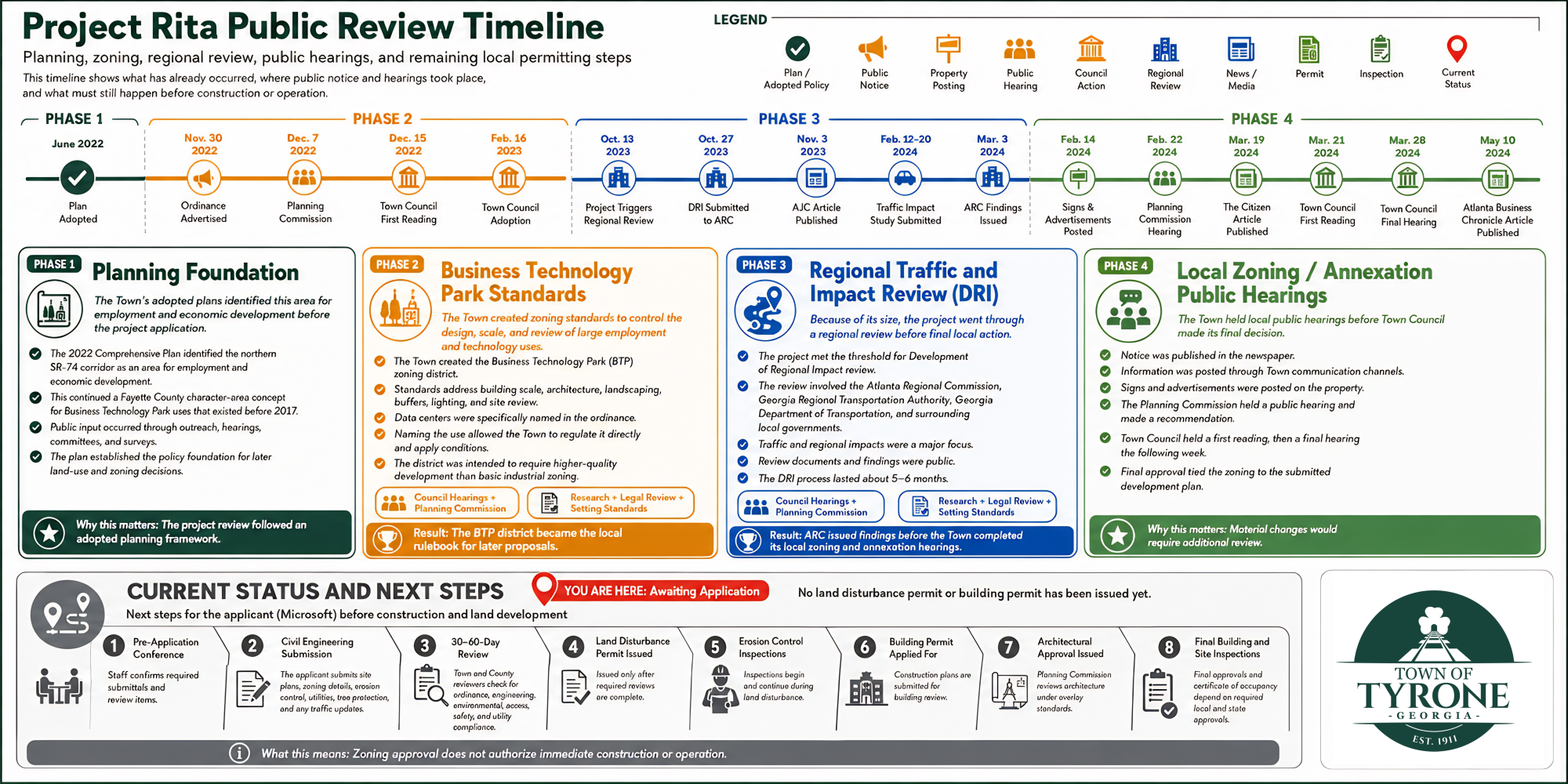
If you have additional questions about this issue, please reach out to staff at info@tyronega.gov.